What does it really cost to run a paid community? (2026 fees) | ProveWorth
·Updated May 23, 2026
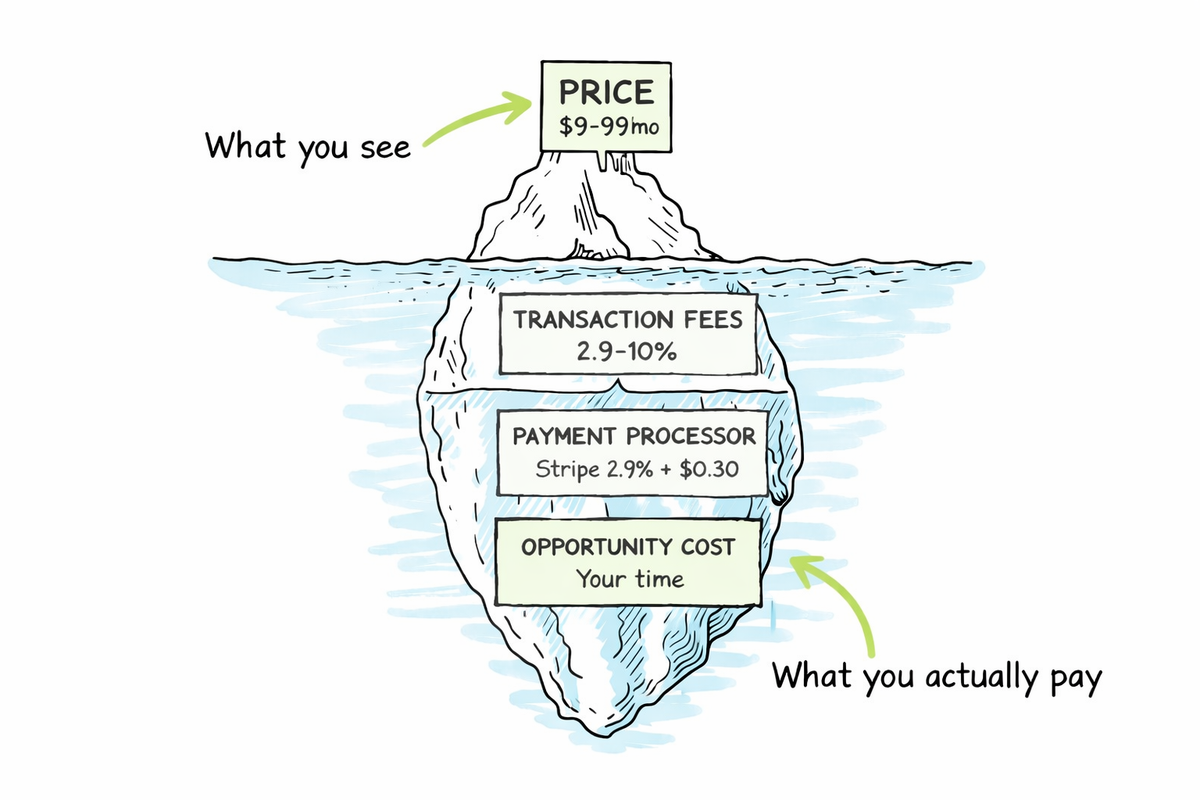
How Much Does It REALLY Cost to Run a Community on Each Platform?
Two builders on identical revenue can net 30 to 60 percent different take-home, based entirely on which platform they picked. Here's the whole iceberg, verified April 2026.
1Two builders with identical revenue can net 30 to 60 percent different take-home depending on which platform they pick. Platform choice is pricing strategy.
2The Iceberg Method: sticker fee + platform transaction fee + payment processor passthrough + Apple/Google mobile tax. Most builders only count the first layer.
3Skool bundles Stripe inside its rate, so Skool Pro at 2.9% beats Circle (2% + 2.9% Stripe) and Mighty (2% + 2.9% Stripe) at scale.
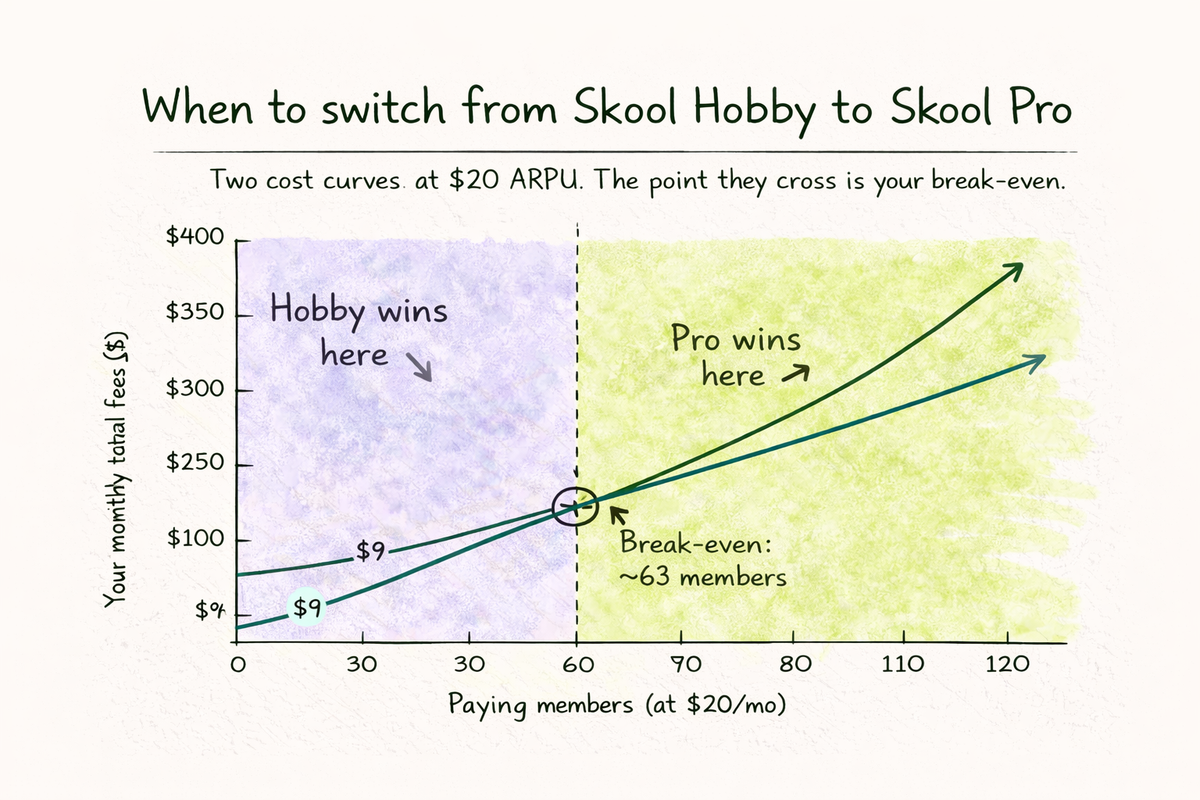
4Skool Hobby-to-Pro break-even at $20 ARPU is ~63 paying members. Below that, Hobby wins. Above that, Pro wins.
5For platforms with mobile apps (Patreon, Discord, YouTube, Twitch, Telegram), steering signups to web is worth 15 to 30 percentage points of revenue.
6At high-ticket low-volume, feature fit can outweigh a $150/mo fee delta. Run your math, then pick on features plus fees, not fees alone.
Here's the thing nobody tells you when you launch a paid community.
You set your price. You launch. You get your first 50 members at $20 a month. You do the math in your head. That's $1,000 a month, recurring, forever.
Glorious.
Then your first payout email shows up and it says $843.
Where the heck did $157 go?!
Most builders never sit down and figure out the actual cost of their platform until they're staring at a payout that doesn't match their spreadsheet. By then they've already picked. They've already told members where to go. Switching feels like pulling teeth.
So here's the headline number, and I want you to sit with it for a second. Two builders with identical revenue, identical members, identical price points can net 30 to 60 percent different take-home based on nothing except which platform they picked. That's a car payment. Or a year of groceries.
Let's look at the whole iceberg.
The sticker price is the tip of the iceberg
Most platform pricing pages show you one number. Skool says $99 a month for Pro. Circle says $89 on annual. Mighty says $79. Patreon says free plus 10 percent. Kajabi says $143 billed annually. Whop says free plus 3 percent.
Look at those numbers. Skool and Patreon look like a steal. Kajabi looks spicy.
But the monthly fee is below the surface compared to everything else that eats your revenue. Below the waterline, you've got transaction fees (a cut of every member payment), payment processor passthrough (Stripe or PayPal takes theirs), Apple and Google's 30 percent mobile tax if your members sign up on their phone, currency conversion losses if your members are international, payout fees when the money actually hits your bank, and the hours you spend stitching together features the platform doesn't include.
Honestly, on a typical $20 community, the monthly base fee is often the smallest single line item. The transaction stack dwarfs it.
The monthly fee is often the smallest single line item. The transaction stack dwarfs it.
Two builders on the same platform, at the same revenue, end up netting wildly different amounts depending on which plan tier they're on, what payment processor they use, whether their members sign up via web or mobile app, and where those members live.
So the question isn't "which platform is cheapest." The real question is which platform nets YOU the most money for YOUR specific situation.
That's a different question. And answering it means looking at the whole iceberg.
The Iceberg Method: four layers of platform cost
I call this the Iceberg Method. Four layers. Three below the waterline that most builders never count. Each one compounds on the one above it.
Layer 1: Sticker fee. The number on the pricing page. Skool Pro: $99/mo. Circle Professional: $89/mo annual. Kajabi Basic: $143/mo annual. This is the only cost most builders notice.
Layer 2: Platform transaction fee. The percentage the platform skims off every payment. Skool Pro: 2.9 percent. Circle Professional: 2 percent. Mighty Launch: 2 percent. Patreon Standard: 10 percent. Teachable Starter: 7.5 percent. This is where budgets go to die.
Layer 3: Payment processor passthrough. Stripe or PayPal takes their cut, usually 2.9 percent plus $0.30. On most platforms this stacks on top of the platform fee. On Skool it's bundled inside the stated rate. That one structural detail is worth hundreds of dollars a month at scale.
Layer 4: Opportunity cost. The hours you spend stitching together things the platform doesn't include. Email sequences you run in a separate tool. Analytics dashboards you rebuild in a spreadsheet. Moderation you handle manually because the platform doesn't automate it. At $50/hour of your time, two extra hours a week on platform plumbing is ~$5,200 a year. That line item never shows up on any pricing page. Sometimes it dominates the iceberg.
Each layer lands on top of the layers above it. A platform that wins on Layer 1 can lose on Layer 4. A platform that looks mid on sticker price can crush on net take-home because it bundles Stripe instead of stacking it on top.
Let me show you what I mean with three builders.
Three builders, three scenarios, real numbers
These three builders are composite profiles, illustrative, not real people. But the numbers are pulled straight from each platform's pricing page and help docs as of April 16, 2026. If Skool or Circle or Mighty changes pricing next quarter, the math shifts, but the framework stays.
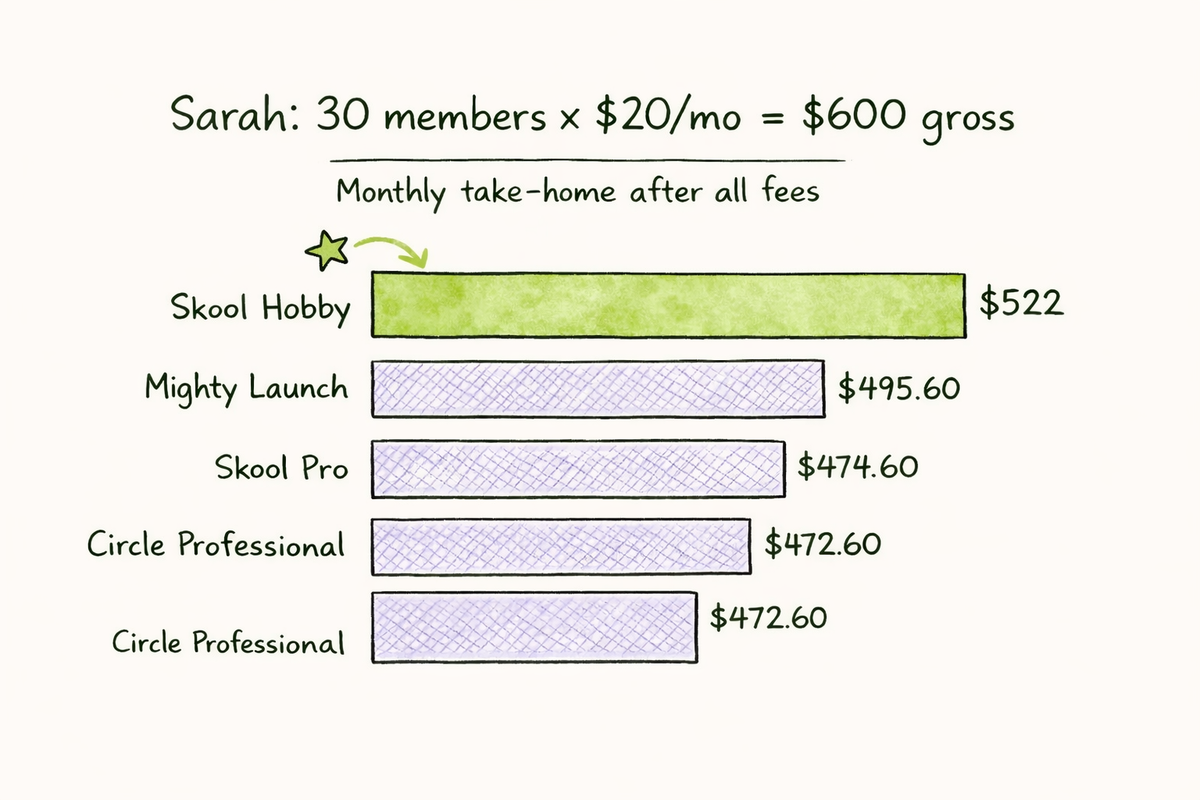
Sarah: 30 members at $20/mo, just getting started
Sarah is a fitness coach. She's been running her program via Instagram DMs for a year and she's finally ready to put her content behind a paywall. She has 30 paying members at $20/mo, grossing $600/mo. She's deciding between the four main community-first platforms.
At Sarah's size, Skool Hobby wins by $26 to $50 a month. The $99 base on Skool Pro and the $89 on Circle both eat a huge chunk of her $600 gross. Even with the scary-looking 10 percent transaction fee, low fixed overhead wins at low volume.
This is the break-even rule, and it's my favorite piece of pricing math: for Skool specifically, the Hobby and Pro plans cross over at roughly 63 paying members at $20 ARPU. Below 63 members, Hobby wins. Above 63, Pro wins. Sarah at 30 members is solidly in Hobby territory.
Sarah's lesson: when you're small, the sticker price dominates. Pick the plan with the lowest fixed cost.
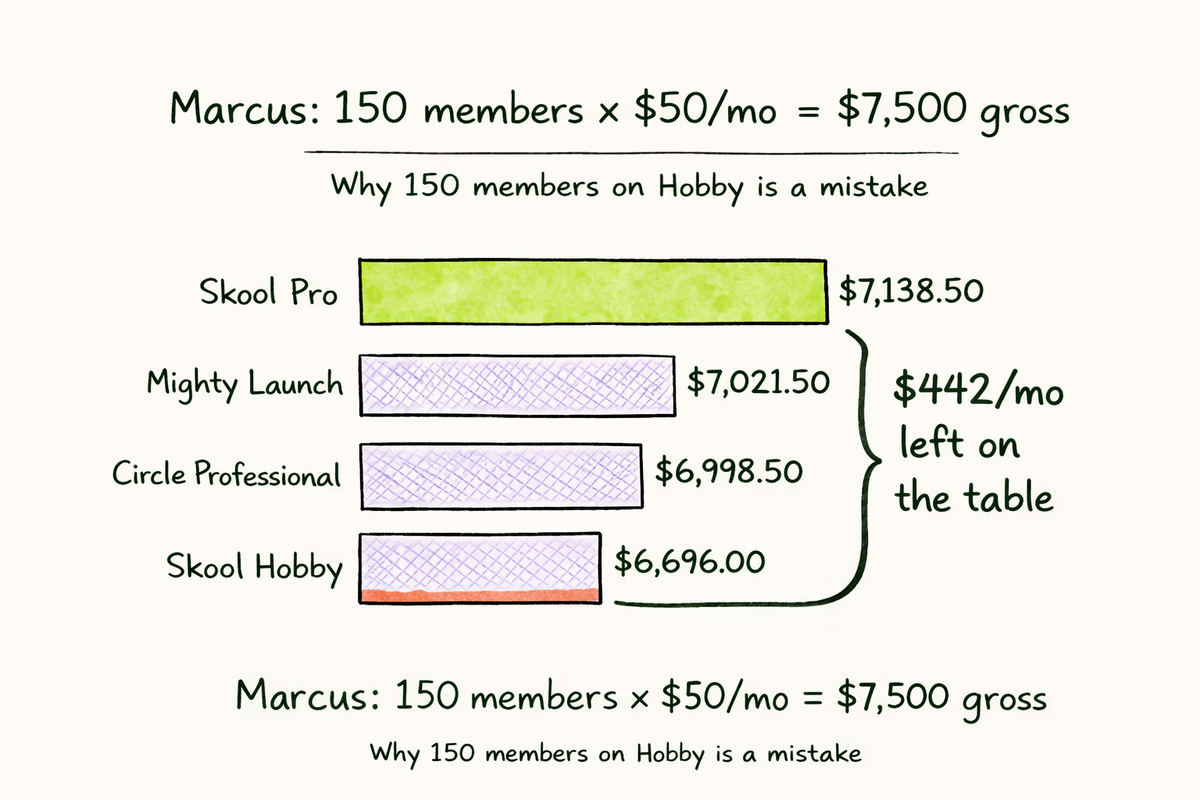
Marcus: 150 members at $50/mo, scaling up
Marcus is a business coach who's been on Skool Hobby for a year. He's at 150 members paying $50/mo, grossing $7,500/mo. He's been paying 10 percent on every transaction plus the $9 base. He's never run the numbers on switching.
Marcus staying on Skool Hobby is leaving $442 a month on the table vs switching to Skool Pro. That's $5,300 a year. For one pricing-page click.
And notice something else. Skool Pro beats Circle Professional by $140/mo and Mighty Launch by $117/mo at Marcus's size.
Why? Because Skool bundles the Stripe fee inside their 2.9 percent. Circle and Mighty stack Stripe on top of their own platform fee. That structural difference, 2.9 percent bundled vs 2 percent + 2.9 percent + $0.30 stacked, shows up as real dollars at scale.
Skool bundles Stripe inside their rate. Circle and Mighty stack it on top. That single detail is worth hundreds of dollars a month at scale.
Marcus's lesson: run the break-even math the day you cross 50 paying members. If you're on any platform's entry tier, you're probably leaving money on the table.
Priya: 20 members at $500/mo, high ticket
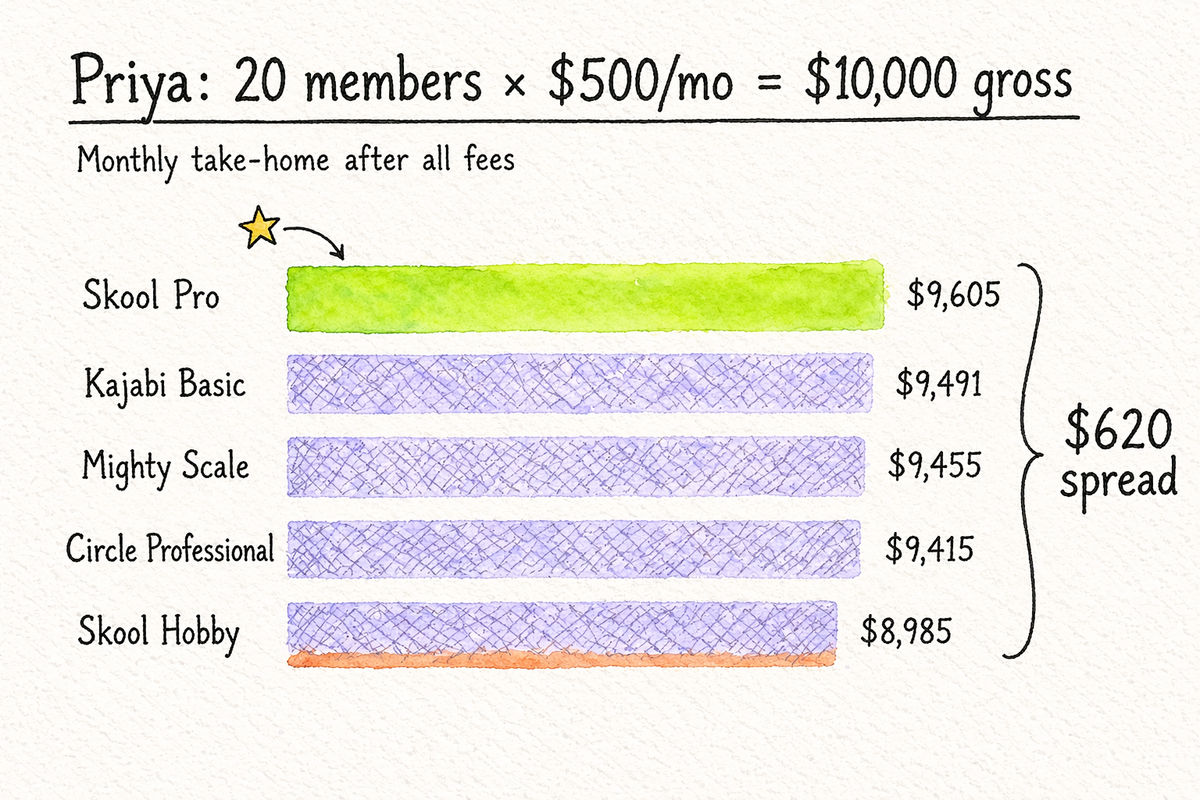
Priya runs an executive coaching mastermind. She has 20 members paying $500/mo for high-touch access. Gross $10,000/mo. At her price point, even fractional fee differences compound fast because the percentage lands on a bigger dollar amount.
Circle Professional ($89 + 2% + Stripe): $10,000 − $89 − $200 − $296 = $9,415/mo
Quick note on Kajabi: the 3.6% above assumes US-domestic recurring. If Priya's clients include international subscribers, Kajabi Basic's intl card (+1.5%) and FX (+1%) surcharges push the effective rate to ~5.1% and the net drops to ~$9,347. Every platform in the list above would take a smaller intl hit than Kajabi on the same mix.
Skool Pro still wins on math, by roughly $100 to $200 a month depending on the competitor. But here's where Priya's story gets interesting. At $500/mo, her members expect a premium experience. A custom domain. Maybe a branded mobile app. A white-glove onboarding flow.
The platforms that offer those features, Circle Business at $199/mo, Mighty Pro (custom quote), Kajabi Pro at $399/mo, charge more in sticker fees. But they justify it with branding and feature depth that a $500/mo clientele actually notices.
Priya's lesson: at high-ticket low-volume, a $150/mo fee delta is real money but it's not the only variable. If one platform gives you a branded experience your clients value by $200/mo, the fee math inverts. Pick on features and fees, not fees alone.
The pattern across all three: there is no universal "cheapest" platform. The right choice depends on your member count, your price point, and your clients' feature expectations. Run your own math at your own scale. But with Skool's $9 Hobby plan, it's easiest to get started and grow into Pro and my personal favorite of the bunch.
The Apple Tax: why mobile signups can cost you 30 percent
There's a fifth cost layer I need to flag, and it's the one most builders have never even heard of. It's not inside the Iceberg Method because it's not universal. It only hits platforms with native mobile apps that process payments in-app. But when it hits you, it hits harder than any of the four layers above combined.
Here's the deal. If your members sign up for your community or subscription through an iPhone app or an Android app, Apple or Google takes 30 percent of that transaction before your platform sees a dime.
Let me say that again. Thirty percent. Off the top. Before platform fees. Before Stripe. Before your share.
This is called the "Apple Tax" or the "App Store fee," and it applies to every platform that has a native mobile app with in-app purchases. That list includes Patreon, Discord, YouTube Memberships, Twitch, Telegram Stars, and Substack. It does NOT apply when your members sign up via the web browser on any device (desktop, mobile web, tablet).
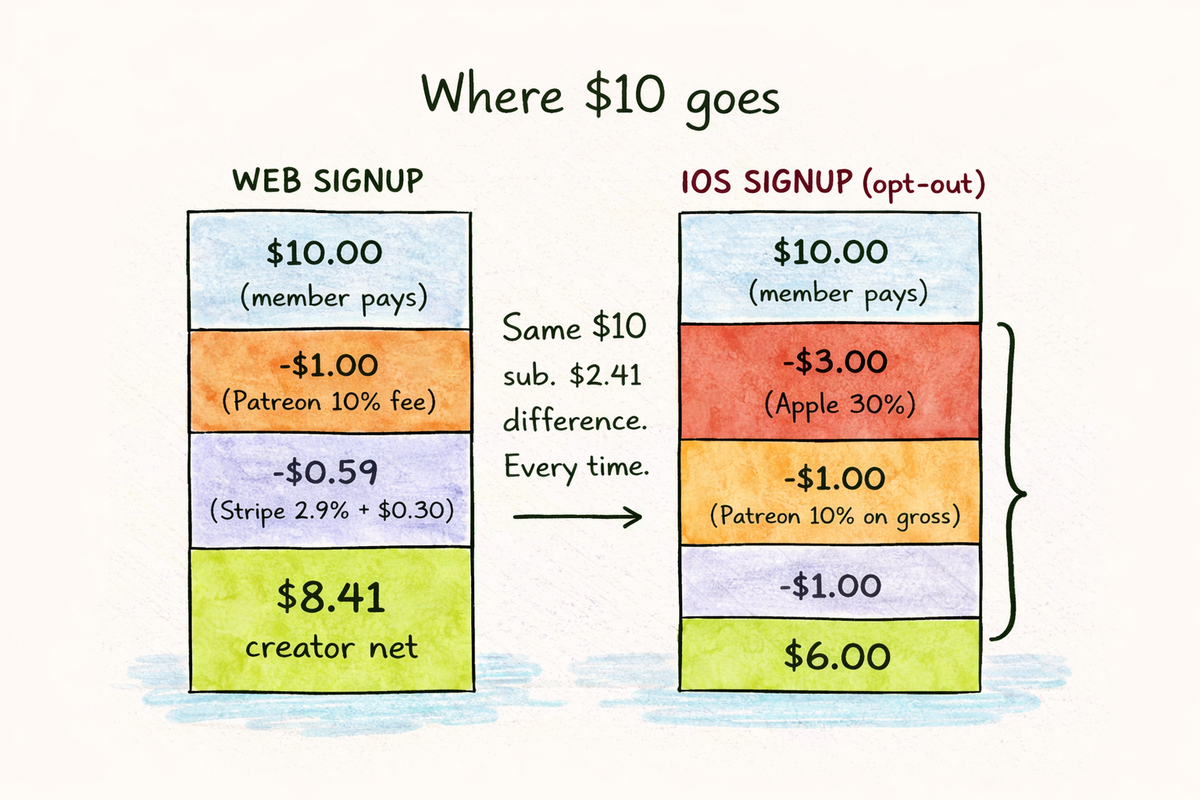
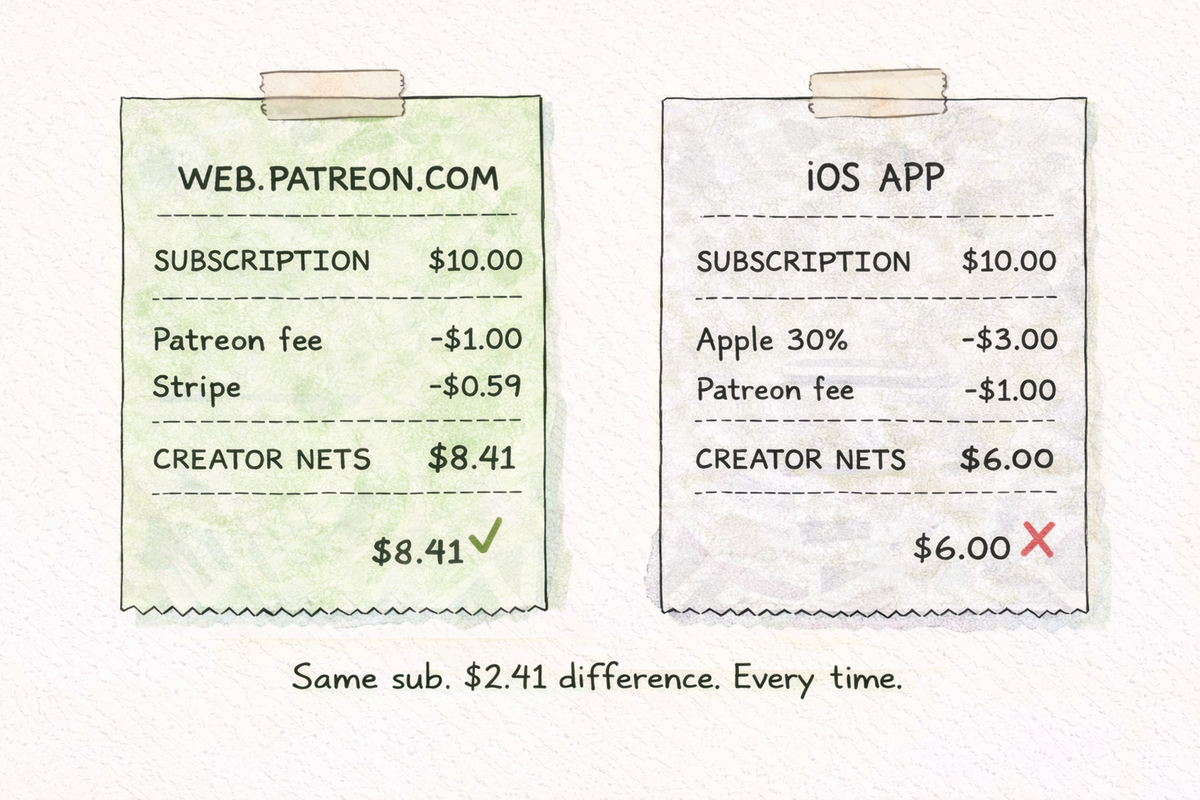
So a $10 Patreon tier tells a different story depending on where your fan clicks subscribe.
On web: fan pays $10. Patreon takes its 10 percent platform fee ($1) plus Stripe's ~2.9% + $0.30 (~$0.59). Creator nets ~$8.41.
On iOS (with Patreon's default upcharge): iOS price auto-inflates to $14.30. After Apple's 30 percent and Patreon's 10 percent, the creator nets roughly the same as web. The fan absorbs Apple's cut via the higher price, not the creator.
On iOS (creator opts out of the upcharge): iOS price stays at $10. Apple takes $3 first. Patreon's 10 percent ($1) still applies on the gross. No Stripe on Apple IAP (Apple handles the payment rails). Creator nets $6.00, a 29 percent haircut vs web.
Every platform has its own workaround. Patreon auto-upcharges iOS prices by ~43 percent so creators don't absorb the loss (US fans can bypass via Patreon's mobile web). Twitch raised Tier 1 mobile subs from $5.99 to $7.99 in October 2024 specifically to offset Apple. YouTube Memberships warn that iOS signups may result in "different pricing or a smaller creator share." Telegram went nuclear and built Stars, an in-app currency that technically complies with Apple's IAP rules. Sophisticated Telegram buyers can also purchase Stars through Fragment on the TON blockchain, which bypasses the tax entirely.
The punchline: for every platform in this guide with a mobile app, steering signups to web is worth 15 to 30 percentage points of revenue. If you're on Patreon, put "subscribe at patreon.com/yourpage" in your pinned tweets and linked-in-bio, not "download the app." If you're on Discord with Server Subscriptions, direct people to the web subscription page. If you're on YouTube Memberships, the creator help docs literally tell you to share the web join URL.
Steering signups to web is worth 15 to 30 percentage points of revenue. Every time. On every platform with a mobile app.
If you're on Skool, Circle, Mighty, or any of the community-first platforms, you're safe from the Apple Tax entirely. Those platforms don't have native monetization through iOS apps (Mighty Pro and Circle Plus offer branded iOS apps, but they route checkout through Stripe web by default). That's actually a meaningful advantage for community-first platforms that I rarely see discussed.
The full 20+ platform fee comparison (April 2026)
Here's every major platform I could verify against its own pricing page, help docs, and community forum as of April 16, 2026. If a platform isn't listed, either I couldn't verify recent pricing (Hivebrite is quote-only, status on Facebook Subscriber Groups is unclear) or it doesn't natively support paid community monetization at all.
Fees drift fast. Twelve of the platforms below have restructured pricing in the last 18 months. If you're reading this more than a quarter after publish, double-check the specific platform's pricing page before committing.
Platform / Tier
Monthly
Transaction fees
Notes
Skool Hobby
$9 ($7.50 annual)
10% + $0.30 (Stripe bundled)
1 admin. Best under ~63 paying members at $20 ARPU.
Skool Pro
$99 ($82 annual)
2.9% + $0.30 on txns ≤$900; 3.9% + $0.30 on txns ≥$901 (Stripe bundled)
Unlimited admins, automations, affiliate system, custom URL. Cheapest all-in among community-first at scale.
Circle Professional
$99 ($89 annual)
2% Circle + Stripe (2.9% + $0.30)
Add-ons: Email Hub $99/mo, extra admins $10/ea, streaming overages.
Circle Business
$219 ($199 annual)
1% Circle + Stripe
Worth it above ~550 members at $20 ARPU over Professional.
Circle Plus
Custom quote
0.5% Circle + Stripe
Includes AI Agents, optional branded iOS/Android apps.
Mighty Networks Launch
$79 ($66 annual)
2% Mighty + Stripe
3 hosts, 200GB, 20 streaming hrs/mo.
Mighty Networks Scale
$179 ($149 annual)
1% Mighty + Stripe
Break-even vs Launch at ~200 members ($50 ARPU).
Mighty Networks Growth
$354 ($295 annual)
0.5% Mighty + Stripe
For larger communities needing lower transaction rate.
10% Discord + processing (6% desktop / 15% auto-renew mobile / 30% other mobile).
Apple 30% stacks on iOS. Web signups bypass. Best Western general-purpose take for community subs.
Whop
No base
3% Whop + 2.7% + $0.30 (bundled processor)
Paid community lives in a Discord server you own. Rolling reserves up to 120 days; a high Dispute Risk Score triggers a 90-day 100% hold per Whop's help docs. Best fit for Discord-native niches (trading rooms, ecom, signals, SaaS resale). Web checkout sidesteps the Apple tax. Trustpilot rating is bimodal (3.7/5, mostly 5-star or 1-star, few in between).
Telegram Star Subscriptions
No base
~5% Telegram fee.
Buyer pays ~$0.01569/Star via Apple/Google (30% IAP markup baked in), ~$0.013/Star via Fragment (TON blockchain). 21-day hold on withdrawals.
YouTube Memberships
No base
30% YouTube (creator gets 70% on web).
Apple/Google 30% stacks BEFORE YouTube's cut on iOS. Creator nets ~49% on iOS vs 70% on web. Steer fans to web.
Twitch Subs (default Affiliate/Partner)
No base
50% Twitch / 50% creator.
Tier 1 web $5.99, Tier 1 mobile $7.99 (raised October 2024 to offset Apple).
Not a community-sub product. US-only, 18+, Persona+Stripe verification. Reddit's paid subreddits announced 2025 are not GA as of April 2026.
Facebook Subscriber Groups / Meta Subscriptions
Status unclear
Not documented.
Meta fee waiver was "until at least 2024." Graph API for Groups deprecated January 2024. Treat as not-reliable.
Slack
$7.25 / $15 per user/mo (Pro / Business+ annual)
No native monetization primitive.
Creators charging for Slack access pay seats + a gating tool (Memberful, MemberSpace, LaunchPass) on top.
WhatsApp Communities
Free
No native monetization.
2,000-member cap per group. Third-party tools (Nas.io, CommuniPass) gate invite links.
Your Turn to Play: run your own math
So what does this mean for YOU?
It means knowing your scenario, not someone else's. The right platform for a 30-member fitness community at $20/mo is the wrong platform for a 200-member business coach at $50/mo. Both are wrong for a 1,000-member free community that monetizes via premium add-ons.
Two paths depending on where you are right now.
Path A: You're already on a platform. Pull your last 3 months of Stripe (or platform) payouts. Compare gross revenue to actual take-home. Calculate your real percentage lost to fees. It's higher than you think. Then ask: at my current member count and price point, would I net more on a different platform or a different tier of my current platform? Use the break-even math from the Marcus case study. Run your numbers against the comparison table above. Switching platforms is painful but switching tiers on the same platform is a two-click job.
Switching platforms is painful. Switching tiers on the same platform is a two-click job.
Path B: You're picking a platform. Don't start with "what's cheapest." Start with "what's my expected member count in 12 months, and what's my expected monthly price?" Plug those into the Iceberg Method for 3 platforms. Pick the one where the math AND the features both work. Don't overweight fees on Day 1. You'll be on this platform for years, and a small fee delta compounds less than a wrong feature fit compounds.
Prefer to have the math done for you? Our community pricing calculator runs the iceberg on all 8 community-first platforms for your exact scenario. Set your member count, your average monthly revenue per member, and your billing cadence. The grid re-sorts live, and you can expand any card to see the full cost breakdown plus how that platform scales with you at 2×, 5×, and 10× your current size.
This week's challenge: open your Stripe dashboard (or your platform's payout page) right now. Find your last payout. Calculate the actual percentage difference between gross revenue and what hit your bank. Write that number down. If it surprises you, you've just discovered why the iceberg matters.
And if you're ever stuck figuring out which platform other builders in your niche actually trust, browse the ProveWorth directory for honest reviews from the members themselves. No affiliate links, no platform favoritism, just what real people said after paying to join.
Methodology and freshness
Every price, fee, and threshold in this guide was verified against the platform's own pricing page or help center on April 17, 2026. The goal is an honest napkin-math reference you can use against your own numbers.
Platforms move pricing constantly. Twelve of the platforms above restructured tiers in the last 18 months. Patreon consolidated to Standard. Circle retired Basic and Enterprise. Mighty renamed Community and Business. Bettermode sunset its Free tier. Ghost removed paid subs from Starter. Memberful collapsed to a single tier. Kajabi did its first price bump in a decade. Teachable overhauled the whole Starter-to-Advanced lineup. Re-verify on the platform's own page before committing your money.
I refresh this guide quarterly.
If you spot a number that looks off or a platform I missed, send me a note and I'll fix it. Thanks for readin' y'all!!
Built ProveWorth - the trust layer for human communities. We surface real reviews from real members across hundreds of communities, so you can find the one that fits and join with confidence.
Frequently Asked Questions
What's the cheapest platform for a paid community?▾
There isn't one. It depends on your member count, your price point, and whether your members sign up on mobile or web. At under ~63 paying members at $20/mo, Skool Hobby ($9 base + 10% bundled) wins on most platforms. Above that, Skool Pro ($99 base + 2.9% bundled) typically nets the most. Teachable's 0%-platform tiers and Ghost Publisher beat Skool at high member counts but only if you can live without a community-first feature set.
Why doesn't my Stripe payout match my expected revenue?▾
Four layers of fees stack on every transaction: the platform's base fee, the platform's transaction percentage, Stripe's 2.9% + $0.30 (unless your platform bundles it, like Skool does), and Apple or Google's 30% if the member signed up on mobile. Currency conversion and payout fees stack on international members. The total gap between gross revenue and what hits your bank is usually 10 to 35 percent depending on the platform.
When should I switch from Skool Hobby to Skool Pro?▾
Run the break-even math. At $20 ARPU, Hobby-to-Pro crosses over at roughly 63 paying members. Below 63, the $9 base on Hobby wins despite its 10% transaction fee. Above 63, Pro's 2.9% bundled rate beats Hobby's 10% by enough to cover the $90/mo extra base. If your ARPU is higher than $20, the break-even drops. At $50 ARPU, it's closer to 25 members.
No. Skool, Circle, Mighty Networks, and the other community-first platforms don't process paid memberships through native iOS or Android apps. Mighty Pro and Circle Plus offer branded mobile apps, but checkout routes through Stripe on the web. The Apple Tax applies to Patreon, Discord Server Subscriptions, YouTube Memberships, Twitch, Telegram, and Substack when members sign up in-app. Web signups on those platforms bypass Apple entirely.
Should I pick a community platform on fees or features?▾
Both, in that order. Run the Iceberg Method on three platforms at your expected 12-month member count and price point. If the fee math is within $100 to $200 a month, pick the platform with the feature set that fits your community best. If the fee math is different by more than $500 a month, that's real money and you should weight it more heavily. Fee savings compound every month you stay. A wrong feature fit compounds as member frustration and churn.
Should I use Whop for my paid community?▾
Whop's 3% platform fee plus bundled processor is among the lowest you'll find for a paid community, and it works well if your audience is already Discord-native (trading rooms, ecom, signals, SaaS resale). The trade-off: the community itself lives in a Discord server Whop doesn't control, and Whop's help docs describe rolling reserves up to 120 days plus 90-day 100% payout holds for accounts flagged by their internal Dispute Risk Score. High-chargeback categories trip the score faster. If a 90-day hold would break your cash flow, or you're building an education-led community where engagement tools matter more than payment plumbing, pick something else. For Discord-first niches where the fit is right, Whop's math is hard to beat.
Built ProveWorth - the trust layer for human communities. We surface real reviews from real members across hundreds of communities, so you can find the one that fits and join with confidence.
ProveWorth Pro
Community Growth on Autopilot
Get your community listed with verified member reviews. Show up when the right people search. Stop chasing members, start attracting them.