Community-led growth, mapped onto a six-stage customer journey, with Electric Callboy as the case study. A German metalcore band built it better than most SaaS.

Founder, ProveWorth
The community-led growth canon is starting to feel exhausted. Notion. Figma. Duolingo. Same three brands, slightly different posts.
So I'd like to nominate a different one.
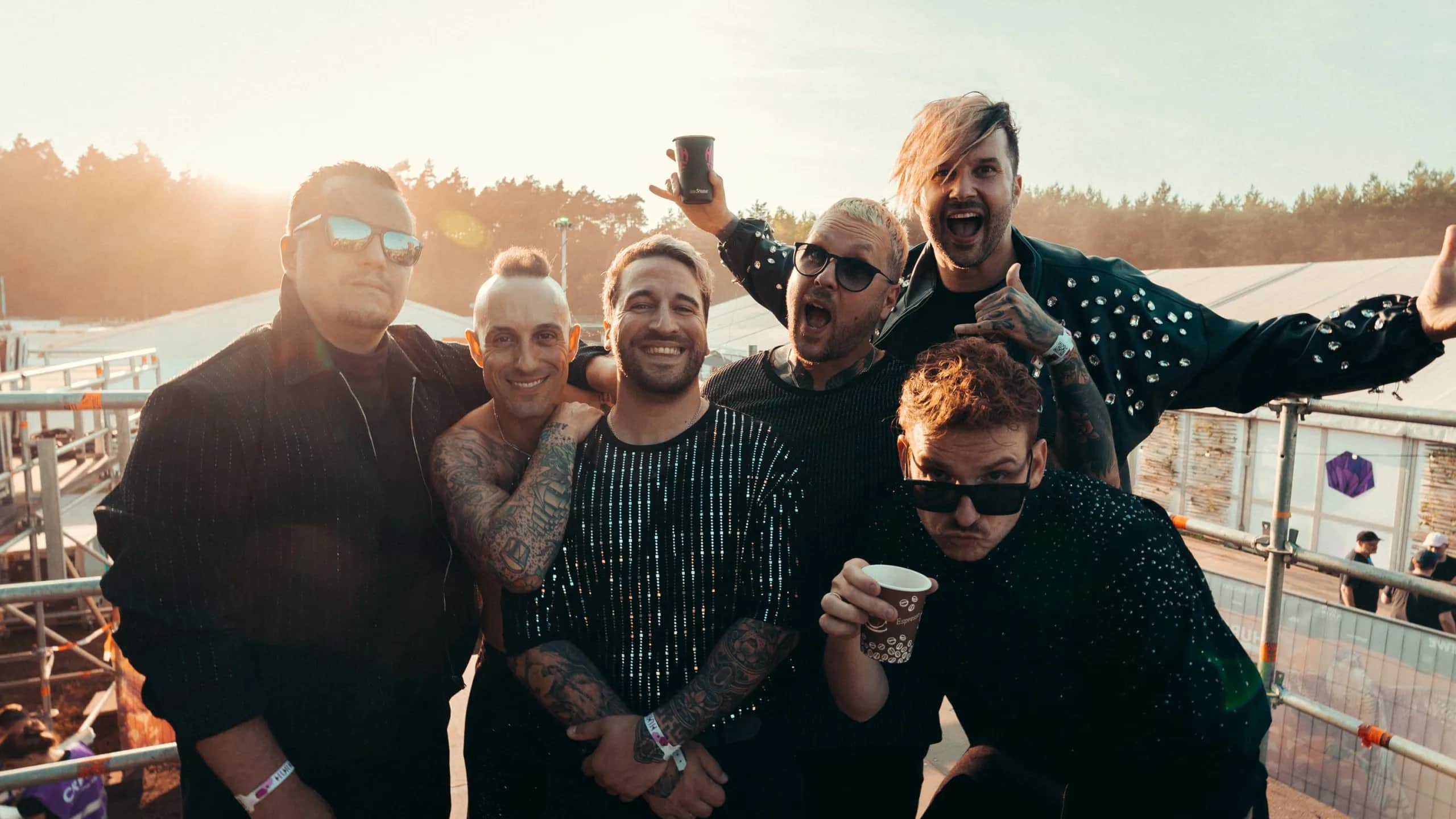
A German metalcore band with one billion streams, two hundred thousand tickets sold, an annual festival their fans show up to in matching costumes, and a crowd ritual where 11,000 people summon a song called "Tekkno Train" by chanting "choo choo" in unison until the band starts playing.
They're called Electric Callboy. They are not a SaaS company. The way they built their fan base maps almost perfectly onto a six-stage community-building framework that every paid-community founder should be using on purpose.
This is that case study.
Community-led growth is the practice of using member participation, member rituals, and member-produced experiences as the primary engine of growth, instead of paid acquisition. Every example you've read about it pulls from SaaS. Notion templates. Figma user conferences. Duolingo on TikTok. The framework underneath those examples works in any category where customers can be turned into participants, and Electric Callboy is the cleanest non-SaaS demonstration of the playbook I've found this year.
Community-led growth is the practice of using member participation, member rituals, and member-produced experiences as the primary engine of growth, instead of paid acquisition. Most case studies on it pull from SaaS. This one does not.
The advantage of a band is the visibility. You can see the fan behavior in real time, in 4K, with a phone in their hand. The fan walks up to the show in costume. The encore gets chanted into existence. The festival has a name. The cosplay is documented. The community happens out loud.
For a builder running a paid community on Skool, Circle, Discord, or Mighty Networks, that visibility is rare. The plays a band runs are the same ones a paid community runs. They are just easier to see when 5,000 people are doing them in tracksuits.
Every community a person joins, free or paid, online or in a venue, moves them through some version of these six stages:
The community-builder's job is to design what happens at each stage on purpose. Most don't. Most paid communities are heavy at the top, leaky in the middle, and silent at the end.
What's interesting about Electric Callboy is they put a deliberate move at every stage and let the fans see it. Six moves, ten years, fully visible. Below is what each one looks like.
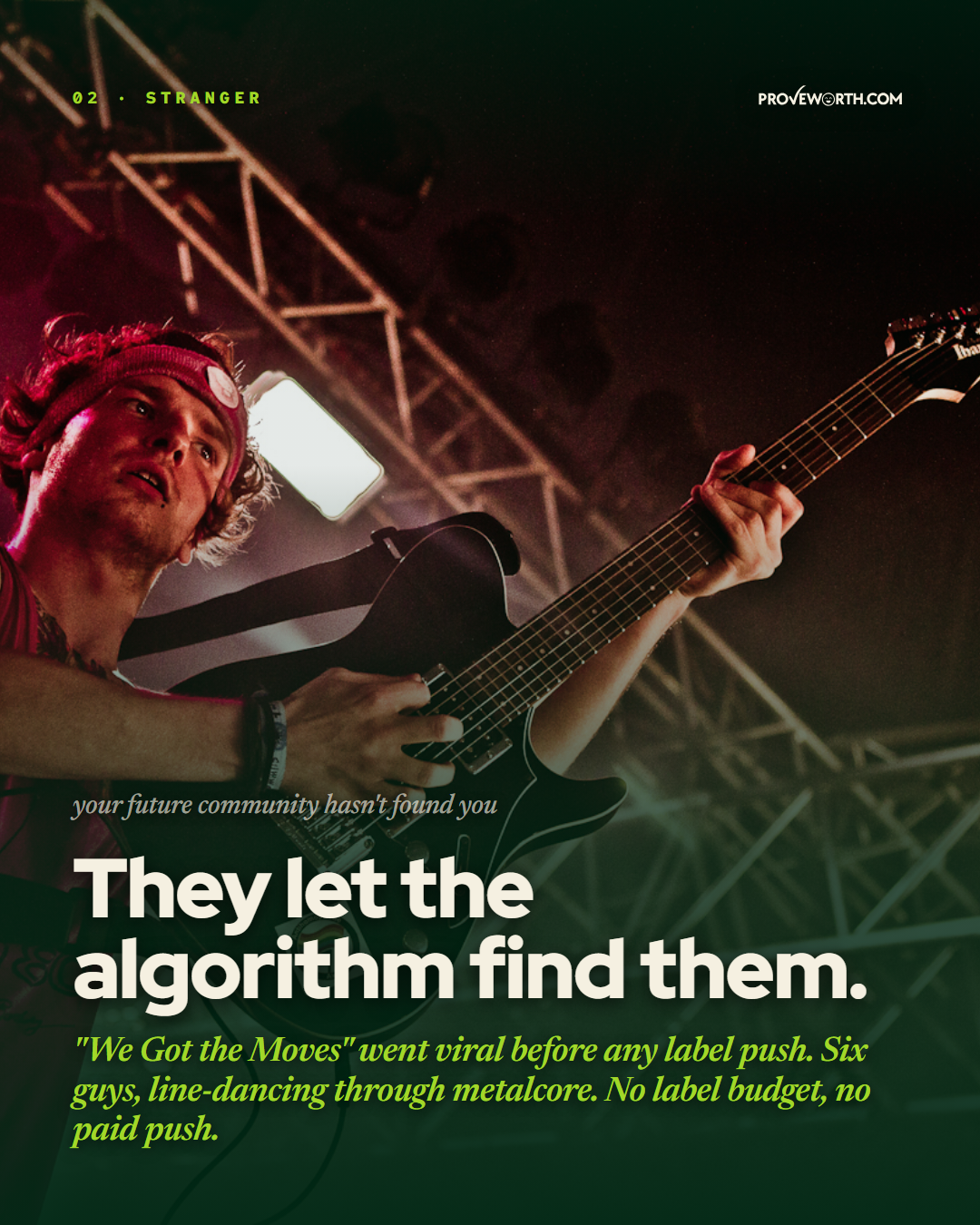
From 2010 to 2020 the band was called Eskimo Callboy. They had a small German metalcore following, the kind of band that headlines Summer Breeze and gets reviewed in Visions but doesn't cross over outside the country.
Then in 2020 they released "We Got The Moves." Six guys in matching tracksuits and fake mustaches, line-dancing through a metalcore breakdown. No label push. No paid budget.
It went viral. Reaction videos started multiplying on YouTube within weeks. The single eventually crossed one billion streams across platforms. Spotify's algorithm started routing the band into recommendation channels they had never paid to enter.
None of that is a community-building move on its own. The community-building move is what they did after the algorithm noticed.
The takeaway for community builders: the algorithm rewards work that is genuinely odd or genuinely useful in a hard-to-copy way. If your work is a sanded-down version of someone else's, the algorithm has nothing to grab onto. If it is specific enough to be remixed and reposted by strangers, that is the move at this stage.
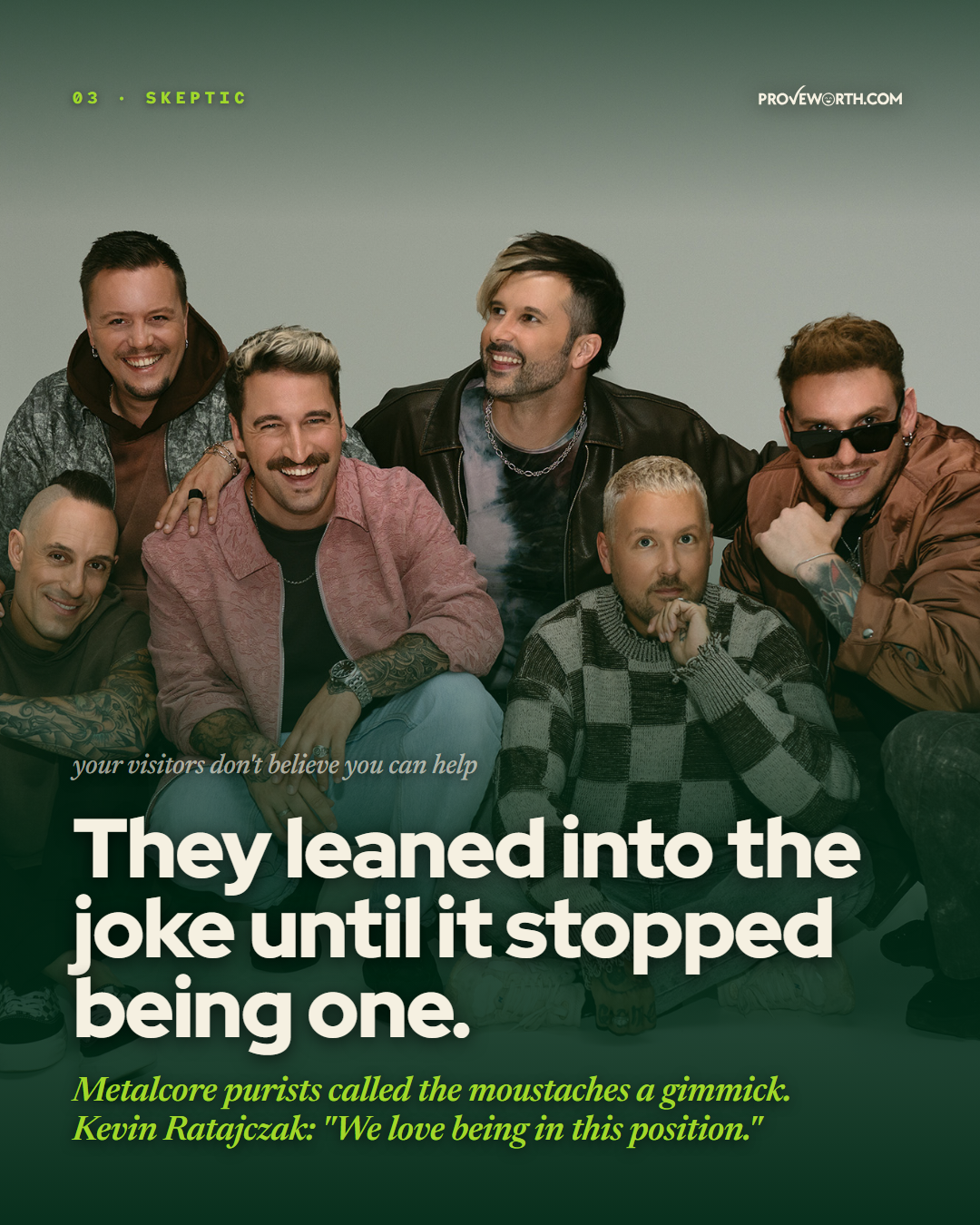
Once "We Got The Moves" went viral, metalcore purists hated it. The band wasn't serious enough. The mustaches were a gimmick. The tracksuits were a gimmick. The whole thing was a gimmick.
Most bands at that fork would soften. Electric Callboy went the other way. They wore the costumes harder. They wrote a song called "Pump It." Then "Hypa Hypa." Then "Tekkno." Then "MC Thunder." They stayed in character for two more albums.
Vocalist Kevin Ratajczak in Kerrang:
"When people say that Electric Callboy makes metal music more accessible to people who consider themselves 'non-metal fans', I think it's very beautiful."
In Louder, he was even more direct: "We love being in this position."
The takeaway for community builders: when a gatekeeper subgroup tells you your community isn't real, you have a choice. Soften and lose your differentiator. Or commit harder and let the gatekeepers exclude themselves. Either is valid. Most builders pick neither and end up stuck in the soft middle, where the differentiator has been edited out and the gatekeepers still aren't sold.
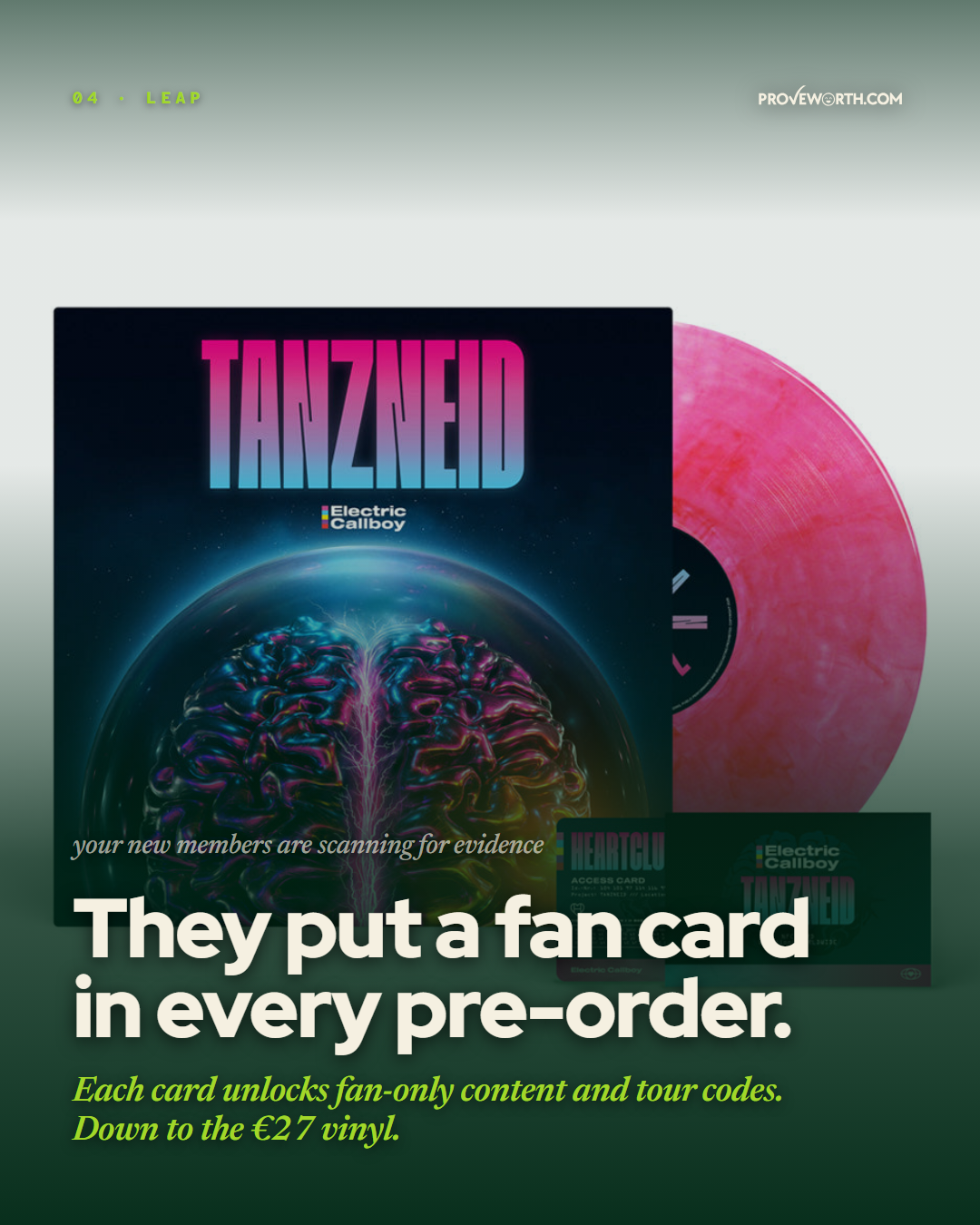
When the band's TANZNEID album went up for pre-order, every product tier, down to the €27 vinyl, came with an NFC-enabled fan card. Tap the card to a phone and the buyer received tour codes, fan-only content, and early access to drops.
This move is small and easy to under-rate. It is the exact move that turns a transaction into a membership.
The first 24 hours after a fan pays is the most anxious window in their entire relationship with you. They have handed over money. The confirmation email hasn't arrived yet. Somewhere in their brain a voice is asking "did I just get scammed." Anything you do in that window that pays off the trust they extended is worth a hundred things you do later.
Electric Callboy's choice for that window: ship the album with an object that activates more value. The fan opens the package and the gift isn't done. There's a card. Tap it on a phone, fan-only content shows up. The transaction has become a membership before the music has even been played.
The takeaway for community builders: design the first 24 hours after payment as if the member is going to ask for a refund. Build in three quick wins, three pieces of evidence, three signals that say "you made the right call." The trust window after a leap is short and load-bearing.
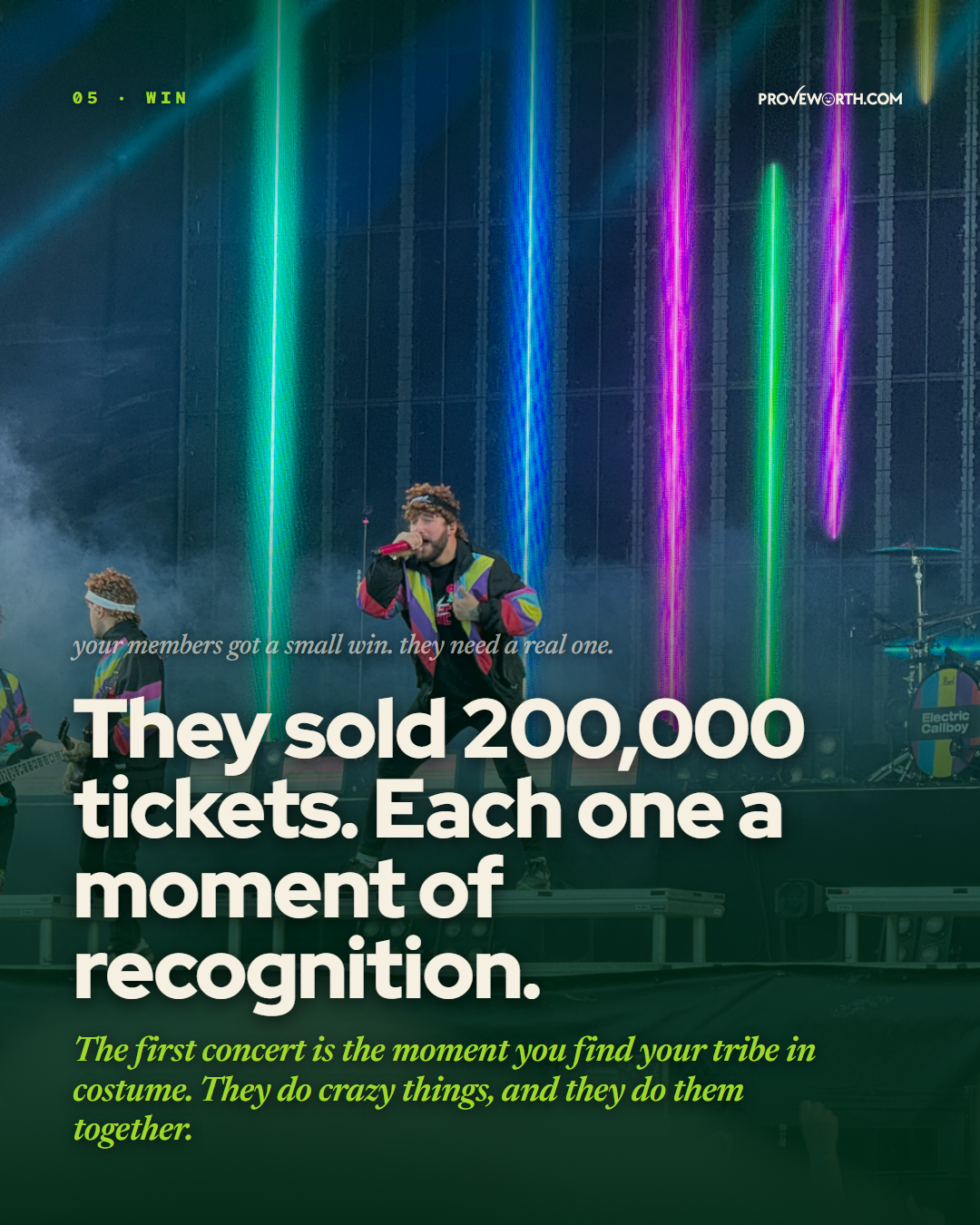
The first concert is the moment a fan finds their tribe in costume.
I want to dwell on this. The Electric Callboy live experience is unusually well documented because reviewers cannot help but write about the crowd before they write about the band. From Rocksound covering Alexandra Palace:
"Fans rubbing shoulders with each other, laughing hysterically and sharing stories on where they picked up their curly wigs and tracksuits."
From When The Horn Blows covering the London Electric Ballroom show:
"A mixture of black, floral, and neon sport tops, fake moustaches and real mullets alongside sweatbands and glitteringly made up faces."
From 1013 Music Reviews covering the Minneapolis Armory:
"People dress up silly, help each other out, the mosh pit is more of a dance party, and there is just such a sense of community and togetherness."
Three reviewers, three continents, almost identical prose. They are describing the same crowd because the crowd has trained itself. The wigs and the mustaches and the matching tracksuits are not handed out at the door. The fans buy them on Amazon. They coordinate before the show. They show up in costume of their own free will.
The "small win" Electric Callboy engineered for stage four was social, not musical. The moment that lands is when a person walks into a room of 5,000 strangers and realizes everyone here also bought a curly wig.
The takeaway for community builders: the first real win in a community is rarely educational. The first real win is the moment a member meets another member and finds out they aren't alone in liking what they like. Design that moment. The first IRL meet, the first synchronous call, the first shared ritual that requires people to show up at the same time. Give your stage-four members a reason to find each other.
Stage five is where most paid communities die. The new-member rush is over. The first wins have happened. The member is busy. They paid for a year, they got value, and now their inbox has 47 other things in it. Without a ritual that returns them to you on the calendar, they will quietly forget you.
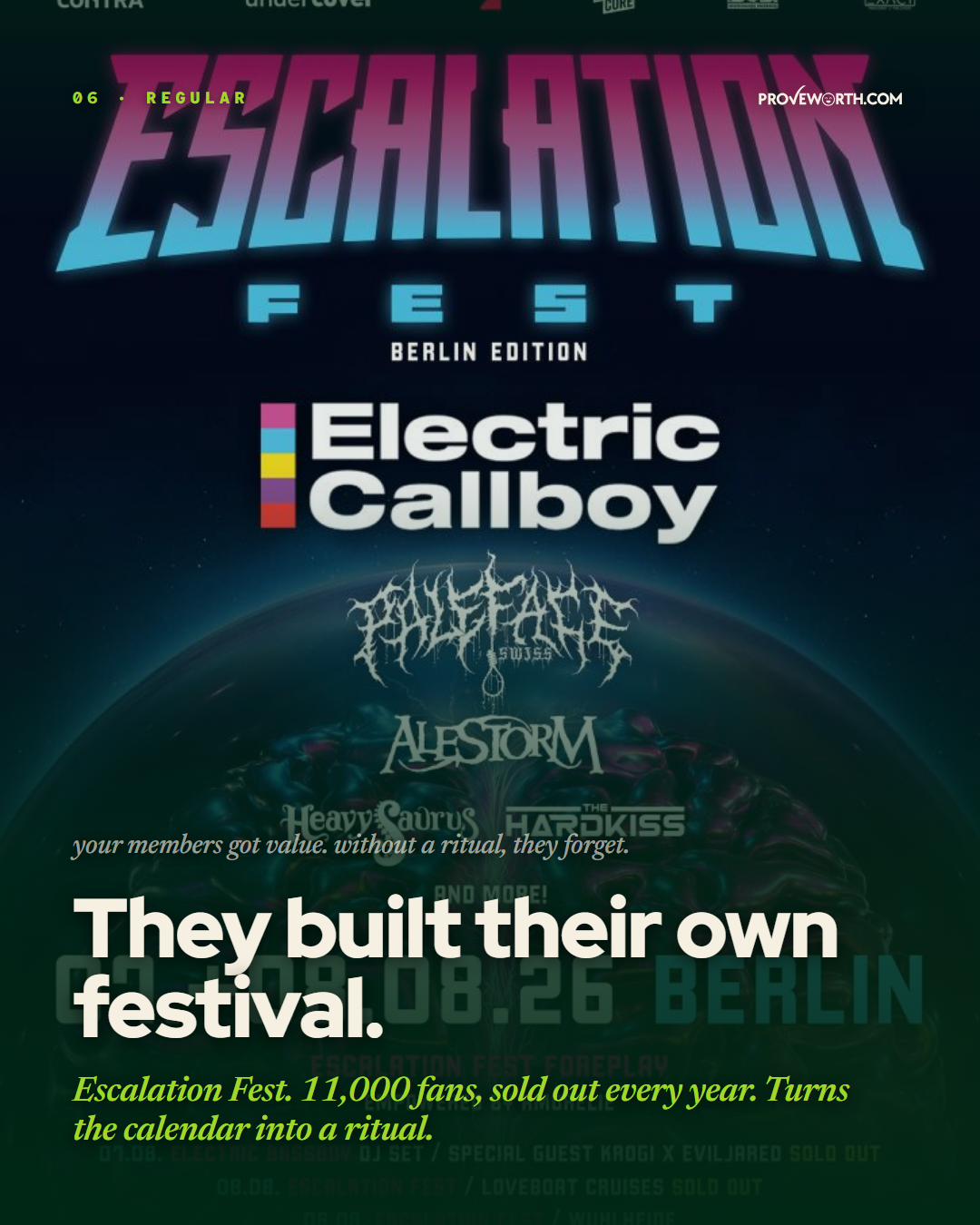
Electric Callboy built Escalation Fest. An annual festival in Germany, 11,000 fans, sold out every year. They headline it. They book the lineup. They turn the calendar into the ritual.
It works because it is a date in the year that exists for one reason. Members don't have to be reminded. The festival is the reminder.
The takeaway for community builders: every paid community needs a calendar event that exists only because the community exists. Quarterly summits. Annual conferences. Monthly first-Friday calls that are sacred. The event itself matters less than the calendar shape it creates. Members get returned to the community on a rhythm they don't have to maintain.
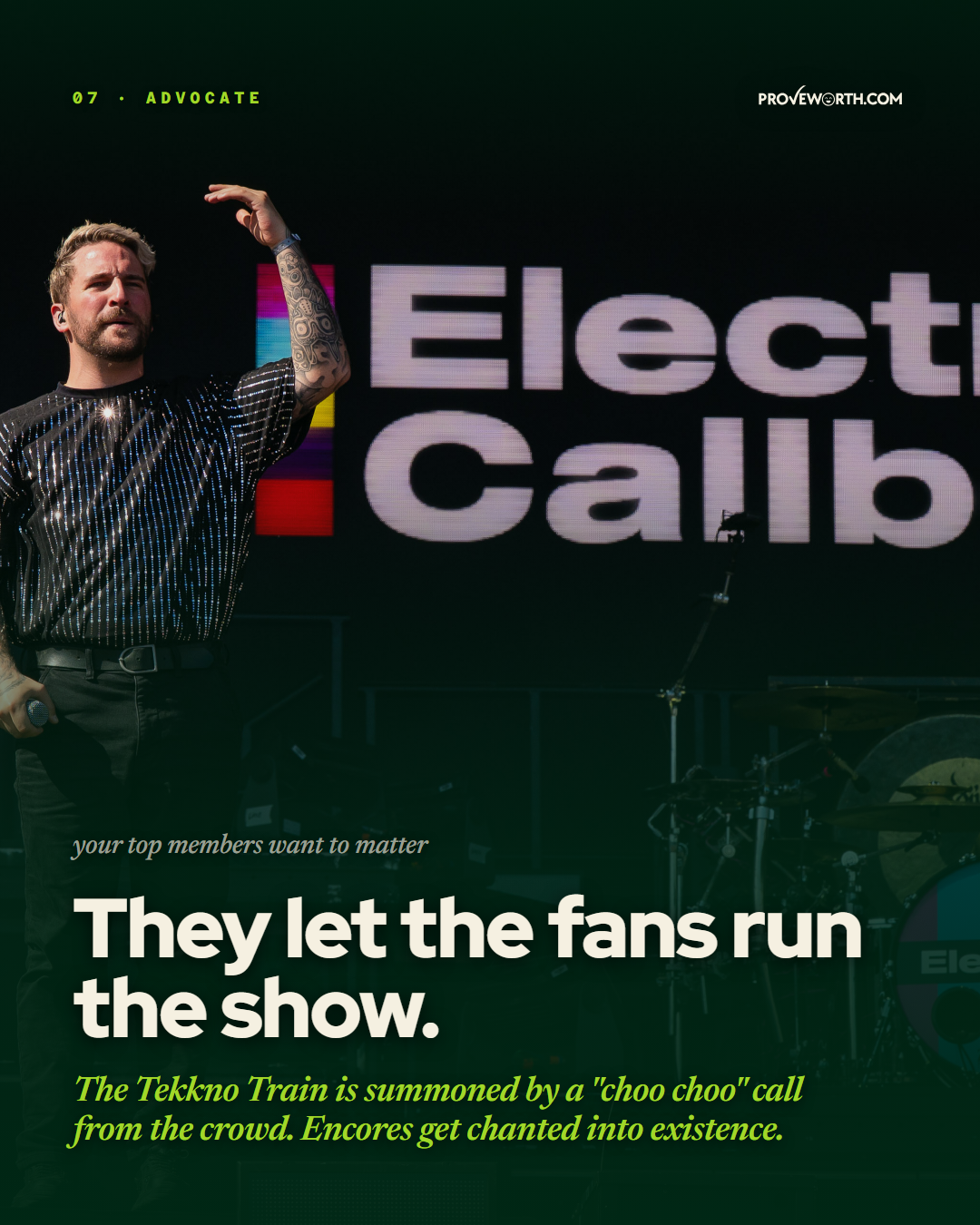
The "Tekkno Train" is a song. It is also a ritual. The band doesn't start it. The crowd does, by chanting "choo choo" together until the band kicks in. The encore gets summoned the same way.
Setlist.fm tour data shows a recurring "Song Request" slot baked into the setlist as a permanent feature. Fans pick what gets covered. The band has institutionalized handing the mic to the crowd.
This is what advocacy actually looks like at scale. The advocate is operating a piece of the show. They are producing the moment. They have a job inside the experience.
The takeaway for community builders: the goal at stage six is the role itself, not a testimonial. Find the members who want to matter and give them a job. Run the new-member call. Host the office hours. Curate the resource library. Lead the cohort. Inside a paid community, the advocate looks like a part-time co-host of the experience itself.
Every Electric Callboy tour I read reviews from has the same engineered emotional pivot. I want to describe it in detail because it is the case-study sentence.
Mid-set, the drummer is on a solo. Vocalist Nico Sallach and Kevin Ratajczak walk down off the stage with a portable piano. They set it up on the venue floor surrounded by fans. They ask the crowd, the same crowd that ten minutes earlier was running circle pits, to sit on the floor, put their phones away, and just sing.
Then they play an acoustic version of "Fuckboi" or "Everytime We Touch." The 5,000 fans sing every word back at them.
And then the full band kicks the song into its breakdown from the stage and a wall of death opens up around the piano. Kevin uses the wall, the literal corridor of bodies the fans have made, to walk back to stage.
Two reviewers describe this in identical language across two continents (Strife Mag covering Rotterdam, 1013 Music Reviews covering Minneapolis) because it is the engineered emotional pivot of every show on the Tanzneid Tour.
What the band did: set the conditions. Walked off the stage. Trusted the crowd to do something difficult on cue.
What the crowd did: sat down on a venue floor that probably had beer on it. Sang every word. Then, when prompted, parted itself like the Red Sea so the band could walk back.
That is what stage six looks like at full volume. The members are part of the choreography.
If your paid community has a moment in it, even one, where the members run a thing that the founder couldn't run alone, you are closer to this than you think.
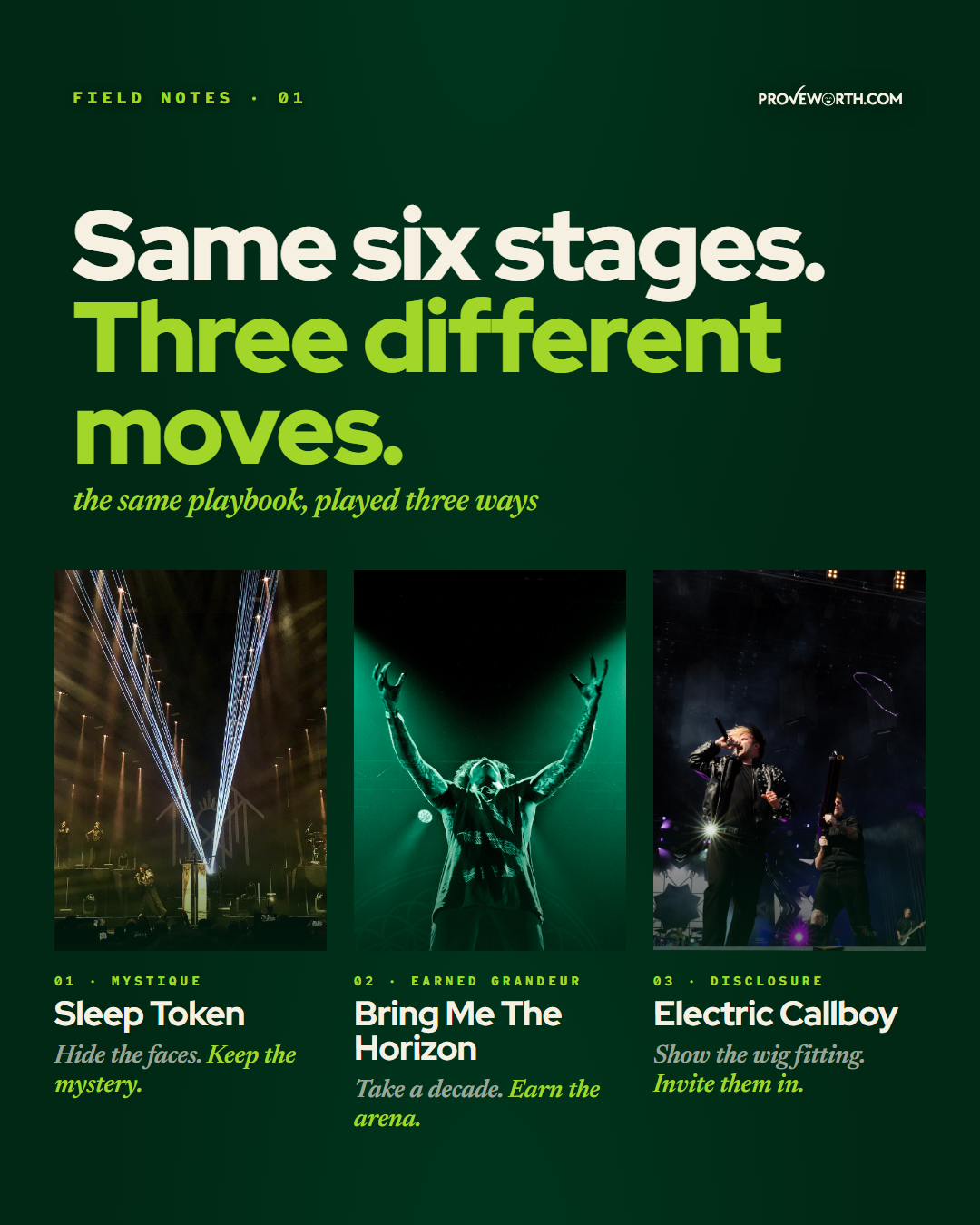
The framework isn't a recipe. The same six stages get walked very differently by different communities. To prove that, here are three contemporary metal bands that all built large fan communities, each on a different lever:
All three communities work. All three are large. All three would tell you their move is the right one.
The point: the framework gives you the stages. You pick the move.
Three things.
One. Design every stage on purpose. Most paid communities are designed at stage three (the leap, where the money changes hands) and barely at all anywhere else. Look at the framework. Look at your own community. Ask which of the six stages has zero deliberate design behind it. That is where the leak is.
Two. Give your members a job. The strongest move at stage six is operational. The advocate is running a piece of the experience for other members. Office hours. New-member welcome calls. Cohort lead. Resource curator. The "advocate" inside a paid community looks like a part-time co-host.
Three. Pick a move and commit. Sleep Token hides. Bring Me The Horizon waits. Electric Callboy shows. None of them split the difference. The communities that wash out are the ones running three half-volume moves because the founder couldn't decide.
Most paid communities feel hollow at scale because nobody mapped the journey. The member shows up at stage three, the founder is happy at stage three, and stages four through six become someone else's problem.
"You can't create community but you can create something that creates community." Jack Butcher, Visualize Value
Electric Callboy is interesting because they made each stage somebody's job. Not always theirs. Often the fans'. But always somebody's. The wig is the costume the fans bought. The choo-choo is the chant the fans started. The wall of death is the corridor the fans built. The band created the something that creates the community.
Don't let discovery happen by accident.
Journeys happen by design.
If you run a paid community on Skool, Circle, Discord, or anywhere else, ProveWorth helps you turn member experience into something prospects can actually verify before they buy. Every review human-audited. See what claiming your community page looks like, or browse more case studies on the blog.

Founder, ProveWorth
Built ProveWorth - the trust layer for human communities. We surface real reviews from real members across hundreds of communities, so you can find the one that fits and join with confidence.
Community-led growth is the practice of using member participation, member rituals, and member-produced experiences as the primary engine of acquisition, retention, and expansion, instead of paid advertising. Most case studies on it pull from SaaS (Notion, Figma, Duolingo). The Electric Callboy case study above is one of the cleanest non-SaaS demonstrations of the same playbook.
Product-led growth uses the product itself to acquire and convert users. Community-led growth uses the community around the product to do the same job. Most healthy companies eventually run both. The community fills in the gaps the product cannot carry alone, like advocacy, retention rituals, and word of mouth.
The five C's vary by source. The common version is Connection, Communication, Communion, Collaboration, and Continuity. The six-stage framework on this page (Stranger to Advocate) covers the same territory in a way that is easier to act on. Think of the C's as the qualities of a community and the stages as the moments where you build them.
Do not start by selling access. Start by designing the moment a new member finds the next member. That is stage four in the framework above. Once members can find each other, the rest of the journey gets easier to maintain. See the takeaway after stage four for the specific move Electric Callboy used.
Both. The six-stage map is a customer journey example, with stages explicitly named, mapped to a real brand, and backed by member behavior you can observe. It is also a marketing case study, in the sense that every stage names a specific marketing move and a specific receipt.
ProveWorth
Reviews from the people who paid, on a URL you keep. The listing is free and the plans that do the asking start at $299 a month.
See the plans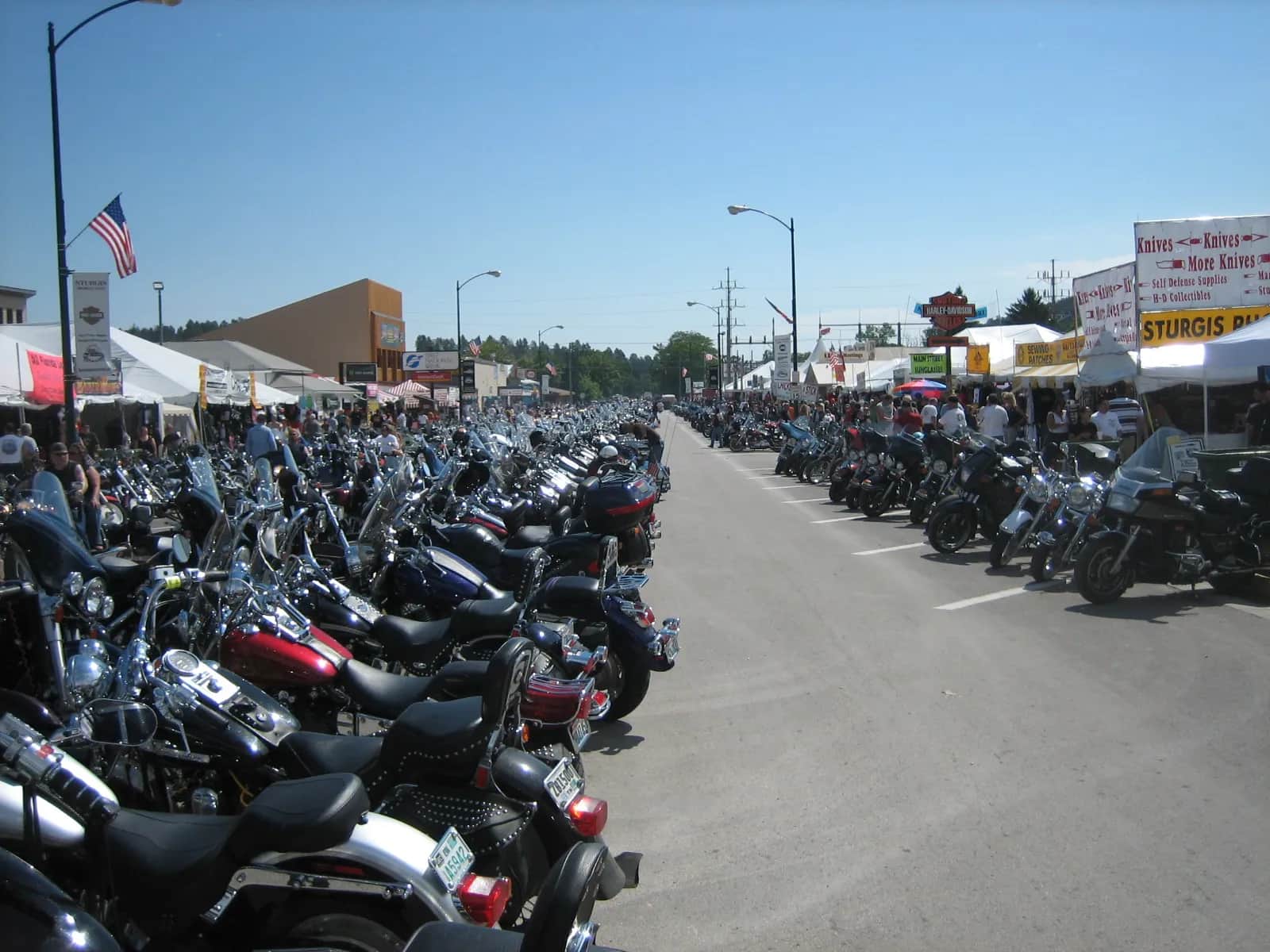
Community-led growth, mapped onto a six-stage customer journey. The 1983 Harley Owners Group program that turned a million customers into 1M+ members across 1,400 chapters in 100 countries.

Discover how Crust & Crumb Academy redefines bread baking education with personalized feedback, science-based techniques, and a community-focused approach.