Published Last updated
GEO vs SEO: what the agency is actually selling you
What an agency means when it sells you GEO, and whether a one-truck business needs it.

Founder, ProveWorth
Key Takeaways
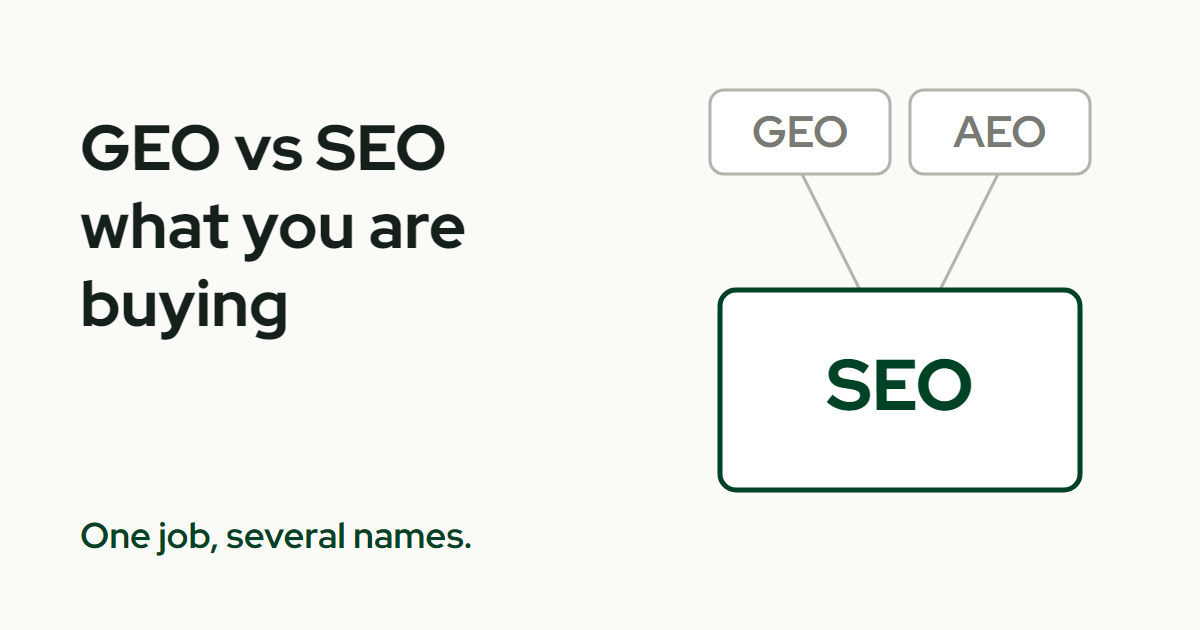
- 1GEO is a label for SEO plus two additions: crawler access and real answers on your site.
- 2Google says optimizing for generative AI search is still SEO, with no additional requirements for AI Overviews or AI Mode.
- 3AEO is another name for the same work, so paying for both buys the same edits twice.
- 4Nobody can promise a spot in ChatGPT or Google AI, so treat a guarantee as a red flag.
- 5Ask any provider for a monthly list of deliverables, the access they need and how they measure results.
GEO is SEO with two additions: let AI search crawlers onto your site, and put real answers on it. Google's own guide says optimizing for generative AI search is still SEO. So a separate GEO bill deserves a question, and checking takes about an hour.
If you just got the pitch, here's the glossary. GEO stands for generative engine optimization. An engine here is any AI tool that writes an answer, such as ChatGPT or Google's AI Overviews.
What is an agency actually selling when it sells GEO?
Usually a bundle of two things: cleanup of your business facts and service page, and a report on whether AI tools mention you.
Those are real jobs. They are also what a decent SEO provider already does. The label is new and the work list mostly isn't.
| What you are told | What the work usually is |
|---|---|
| SEO | Clear service pages, a complete Google Business Profile, reviews, pages search tools can read |
| GEO | The same list, plus a crawler check and pages that answer customer questions |
| AEO | The same list again, aimed at answer boxes and assistants |
If you already pay for SEO, you may be asked to buy the same edits under a second name. Three differently named subscriptions doing the same edits are not three times the value.
Is GEO different from the SEO I already pay for?
Google says no. Its guide on optimizing for generative AI search names GEO and AEO directly and calls the work still SEO.
Its AI features page adds that there are no additional requirements to appear in AI Overviews or AI Mode, and no other special optimizations. Google also says you don't need to write in a specific way just for generative AI search.
There is one catch. A page has to be indexed and eligible to show in Google Search with a snippet before it can appear in a Google AI feature. Ordinary indexing comes first.
What are the two additions?
Two things are worth a look that a plain SEO checkup might skip.
- Crawler access. AI assistants send their own bots to read sites. If your robots.txt file or your host's bot settings turn those bots away, they can't read you. The llms.txt and AI crawlers guide walks through the free check.
- Real answers on the site. A page that plainly states what you do, where you work and what a visit involves gives any search tool something accurate to read. That is good SEO too, and Google doesn't ask for a special format.
Neither one needs a new subscription. The first is a ten-minute look. The second is an afternoon with your own service pages.
Is AEO any different from SEO?
AEO stands for answer engine optimization. It aims at being the answer a search tool gives, rather than one link in a list.
Google's guide puts AEO and GEO in the same answer: optimizing for generative AI search is still SEO. It also says you can ignore tactics like "chunking" content into tiny pieces.
In practice an AEO pitch asks for the same two things: answer customer questions plainly on your pages, and make sure search tools can read them. If you have paid for GEO, you have already paid for AEO.
Do I need GEO if I have one truck and a Google Business Profile?
You need the basics, and you probably have part of them. Google says local results are mainly based on relevance, distance, and popularity. It also says more reviews and positive ratings can help your local ranking.
That line is about Google's local ranking, and Google makes no such claim for AI answers. Keep doing it anyway. A customer may see you in an AI answer, check your reviews on Google, then call.
So don't drop your Maps profile or your service pages to fund an experiment you can't measure. AI search is one more place to be found, and it sits on top of the old ones.
Can anyone promise I will show up in ChatGPT or Google AI?
No. Google says a page can meet every requirement and still not get indexed or shown. ChatGPT and Perplexity are separate products, and nobody who sells you a service controls them.
These are the pitches to walk away from:
- Guaranteed placement in any AI tool.
- A proprietary score presented as the search engine's own number.
- An AI text file or schema script sold as a replacement for useful information on your pages.
- A page for every city or prompt whether or not it adds anything. Google says using generative AI to make many pages without adding value may violate its scaled content abuse policy.
- Fake reviews or invented job photos. Skip any provider who offers them.
What should I ask a provider to show me before I pay?
Ask for four things in writing.
- The list of deliverables each month, in plain words.
- The accounts and access they need, and who owns them if you leave.
- The outcome they measure, such as calls or form fills.
- Who maintains the work after month three.
A good answer names edits to your pages and your profile. A weak answer names a dashboard.
How do I tell whether AI sends me any customers?
Ask people how they found you. It takes one sentence on the phone and beats any report.
Then read how to track AI visibility for the monthly check. For the buying side, AI SEO for small service businesses covers what to buy and what to skip.
What do I do next?
This week, ask your SEO provider one question: which of these two additions is already in my plan? Then open your own robots.txt file and read it.
Want your customer reviews on one more page that search tools can read? You can get your free page on ProveWorth, or see how it works.
Sources

Founder, ProveWorth
Built ProveWorth - the trust layer for human communities. We surface real reviews from real members across hundreds of communities, so you can find the one that fits and join with confidence.
Frequently Asked Questions
What is GEO in plain words?
GEO stands for generative engine optimization. It means making your business easy for AI tools like ChatGPT to find and describe. Google's guide calls that work still SEO.
What is AEO?
AEO stands for answer engine optimization. It aims at being the answer a search tool gives instead of one link in a list. In practice it is the same work as SEO and GEO.
Is GEO different from SEO?
Google says optimizing for generative AI search is still SEO. The two additions worth checking are whether AI crawlers can read your site and whether your pages answer customer questions plainly.
Do I need to pay for GEO if I already pay for SEO?
Probably not as a separate service. Ask your SEO provider whether the crawler check and the answer pages are already in the plan before you add a second bill.
Can anyone guarantee I will show up in ChatGPT or Google AI?
No. Google says a page can meet every requirement and still not be indexed or shown. A promised placement is a red flag.
Should I drop Google Maps work to pay for GEO?
No. Customers still find you on Maps, in search and through referrals. A customer may see you in an AI answer, check your Google reviews, then call.
ProveWorth
Reviews on your own page
Your business gets a free page and your customers write what goes on it. We read each review, publish it, and email you so you can reply.
Get your free pageSee the websites we buildRelated Guides
How to track whether AI recommends your business
Ask three assistants the question your customer asks, once a month, and write down what they say. Tools come second.

Nextdoor for a local service business: the free page, the paid options and how to tell them apart
The Business Page is free. Paid promotion is separate, and Nextdoor prints no price for it. Here is how to set up the page and track each result.
Can you delete a Google review?
Who can delete one, what you can report instead, and the one shortcut that gets a business in trouble.