
Published Last updated
What does a new customer cost your service business?
A worked table, the one-truck example, and the few numbers worth writing down each month.

Founder, ProveWorth
Key Takeaways
- 1Customer acquisition cost is what you spent to win new customers, divided by the new customers you won in the same stretch.
- 2Cost per lead and cost per customer are different numbers, and the cheaper lead can be the costlier customer.
- 3A customer pays you back when the money left after each visit adds up to what you spent to win them.
- 4ROAS counts revenue per ad dollar, so it can look strong while the jobs still lose money.
- 5Write down spend, inquiries, new customers and how each one heard about you, month by month.
Customer acquisition cost is what you spent to win new customers, divided by how many new customers you won in that same stretch. In a hypothetical example, a $400 door-hanger run that signs five new customers cost $80 a customer. Divide by inquiries instead and you get cost per lead, which is a different number.
Every dollar figure on this page is a hypothetical example unless it links to a source. Put your own numbers in the same slots.
How do I work out what a new customer cost me?
Owners and marketers shorten the name to CAC. The math takes three steps, and all three use the same time window.
- Add up everything you spent to find customers in the period: ads, printing, postage, listing fees, software and your own hours.
- Count the new customers you won in that same period. A returning customer goes in a separate count.
- Divide the first number by the second.
Then write down what you left out. If your own hours are missing, say so next to the number, so next month's figure means the same thing.
What counts as spend, and do I count my own time?
Count anything you would not have paid for if you had skipped finding customers that month. Printing, postage, an ad budget, a listing fee and a discount you gave a new customer all qualify.
Your own time is the line most owners skip. Count it if those hours would otherwise earn money, at a rate you pick and keep fixed. A CAC without your time is still useful, as long as it says so.
Is a cheap lead a cheap customer?
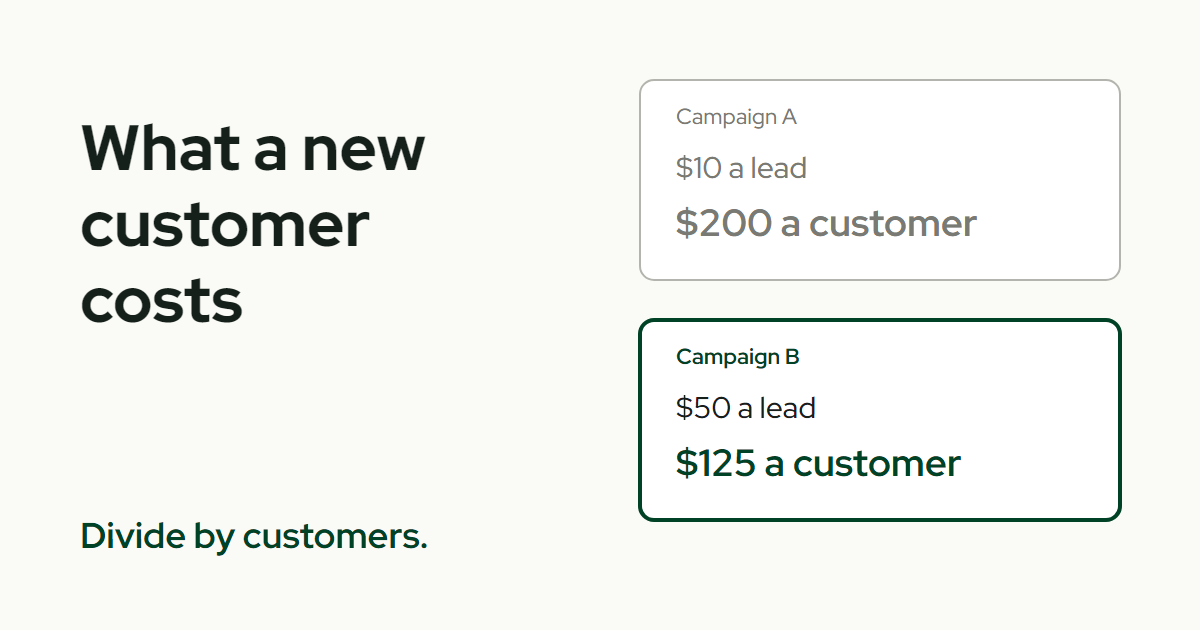
Not always. Here are two campaigns with the same $1,000 budget. The numbers are hypothetical and are not an industry benchmark.
| Campaign | Spend | Inquiries | New customers | Cost per lead | Cost per customer |
|---|---|---|---|---|---|
| A | $1,000 | 100 | 5 | $10 | $200 |
| B | $1,000 | 20 | 8 | $50 | $125 |
Campaign A has the cheaper lead. Campaign B has the cheaper customer, and customers are the ones who pay you.
Before you pick B, check that its customers are comparable and that the jobs got done and paid. Also check that you counted your time and design costs in both rows.
Lead quality is a real worry. The FTC's final order against HomeAdvisor included up to $7.2 million for redress, and it covered how that company described its leads. It is one company's case, so don't read it as a verdict on every lead service. It is a good reason to follow your own leads from first call to payment.
How long until a $45-a-month customer pays me back?
Take a hypothetical route customer who pays $45 a month. Say you spent $180 to win them, and after labor, fuel, bags and disposal you keep $27 of each $45. That is 60 percent. It is my assumption for the example, so use your own share.
$180 divided by $27 is 6.7 months. The table shows how that answer moves when the share you keep changes.
| Share of the $45 you keep | Kept each month | Months to pay back $180 |
|---|---|---|
| 100 percent (no costs, for comparison) | $45 | 4 |
| 60 percent | $27 | 6.7 |
| 40 percent | $18 | 10 |
The same $180 comes back in 4 months or in 10, depending on how much of each payment you keep. If customers tend to leave before that month, the spend never comes back.
For the longer version of this arithmetic, read how to calculate customer lifetime value on a route and the short answer on CAC payback period.
What is the difference between ROAS and ROI?
ROAS is revenue per ad dollar. Google Ads' own example is $5 in sales for $1 of ad spend, which it writes as a 500 percent target ROAS. It counts sales and says nothing about profit.
ROI is what is left after all costs. A campaign can post a big ROAS and still lose money once you pay for labor, materials and overhead.
A landscaping postcard case shows the gap. PostcardMania reports 15 new customers, $30,000 in revenue and $3,686 invested, and calls that a 714 percent ROI. That figure is revenue minus spend, divided by spend. It leaves out the cost of doing the jobs.
From the same inputs, each new customer cost about $245.73, which is $3,686 divided by 15. Revenue came to 8.14 times spend. Those inputs are the vendor's own, so treat the math as a check on the arithmetic and nothing more. The short answer on ROAS versus ROI goes further.
What should I write down each month?
One row per month is enough. Keep each channel on its own line so each one gets its own cost per customer.
| What to log | Why it matters |
|---|---|
| Spend, by channel | Each channel gets its own cost per customer. |
| Inquiries | The count of real people who asked for work. |
| Qualified inquiries | The ones in your area, for a job you actually do. |
| Quotes or bookings | Shows where people drop out between asking and agreeing. |
| New customers | The number you divide by. |
| How each one heard about you | Ask on the first call and write the answer down. |
| Paid and completed | Shows whether the job got done and the money arrived. |
| Returning customers | Kept apart so they don't flatter the new-customer number. |
Google Analytics 4 uses the same idea. It has separate events for a form submitted, a lead marked as qualified, and a lead that became a customer. A website can count each stage on its own.
What do I do next?
Open a sheet and fill in last month. A rough month of spend and new customers gives you a number to beat.
Then pick one channel and price it first. The guides on Nextdoor, Every Door Direct Mail and door hangers cover ways to find customers that you can price this way.
A free ProveWorth page gives the next customer a place to read your reviews before they call. You can get your free page or see how it works.
Sources

Founder, ProveWorth
Built ProveWorth - the trust layer for human communities. We surface real reviews from real members across hundreds of communities, so you can find the one that fits and join with confidence.
Frequently Asked Questions
What does customer acquisition cost mean?
It is the money and time you spent to win new customers, divided by how many new customers you won in the same period. Returning customers are counted separately.
Do I count my own time?
Count it if those hours would otherwise earn you money. Pick an hourly figure, write it down, and use it every month so the numbers stay comparable.
What is the difference between cost per lead and cost per customer?
Cost per lead divides spend by inquiries. Cost per customer divides spend by the people who signed up and paid. Only the second one tells you what growth costs.
How do I count a customer who comes back?
Keep returning customers in their own column. They were already won once, so counting them as new makes your spend look cheaper than it was.
What can I afford to spend per new customer?
Less than you expect to keep from them after paying to serve them, with room left for overhead. Do not spend the whole lifetime amount.
How do I track this without software?
Use a sheet with one row per month. Log spend by channel, inquiries, new customers, and the answer to how each new customer heard about you.
ProveWorth
Reviews on your own page
Your business gets a free page and your customers write what goes on it. We read each review, publish it, and email you so you can reply.
Get your free pageSee the websites we buildRelated Guides
Nextdoor for a local service business: the free page, the paid options and how to tell them apart
The Business Page is free. Paid promotion is separate, and Nextdoor prints no price for it. Here is how to set up the page and track each result.
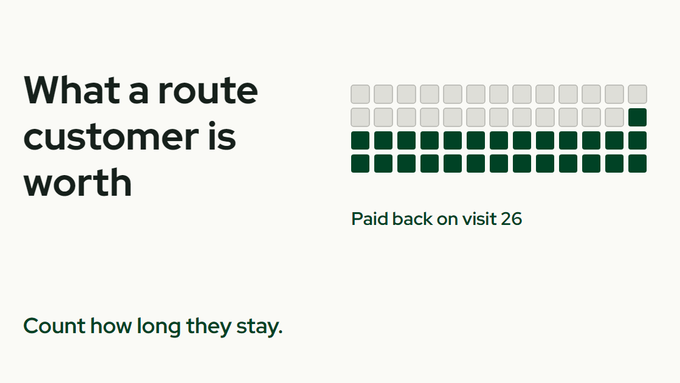
How to calculate what a weekly route customer is worth
Weekly route arithmetic, step by step, with the one number you have to measure instead of guess: how long customers stay.
Door hangers for a service business: what to write and where they go
A layout with one offer and one phone number, three copy examples, the mailbox rule and the nearby-job move.