
Published Last updated
How to calculate what a weekly route customer is worth
Weekly route arithmetic, step by step, with the one number you have to measure instead of guess: how long customers stay.

Founder, ProveWorth
Key Takeaways
- 1Lifetime value on a route is the money left per visit, times the visits a customer stays for.
- 2Your price and your cost per visit are known. The weeks a customer stays are not, so count them from your own list.
- 3A customer who leaves in the first month leaves you short of what you spent to win them.
- 4A stop that adds travel cuts what you keep per visit, so the same price takes longer to pay back.
- 5A weekly customer pays again next week, which is why a route business can spend more to win one than a one-time job allows.
Customer lifetime value on a route is the money left after each visit, multiplied by the number of visits the customer stays for. The price is on your invoice. The weeks are the hard part, so count them from your own customer list. A guess there can hide a loss.
How do I calculate it, step by step?
I'll use a real published price and a made-up cost. FetchPoop, a pet waste company in Northern Colorado, publishes weekly service at $12 a visit for one dog. Your own price goes in the same slot.
- Price per visit. $12.
- Visits per year. Weekly means 52, so $12 times 52 is $624 a year, or $52 a month.
- Cost of one visit. Say $5 for labor, fuel, bags and disposal. This number is a hypothetical. Yours comes from your own books.
- Money left per visit. $12 minus $5 is $7.
- Multiply by the visits the customer stays for. The table does that for five stays.
Now set it against what you spent to win the customer. Say that was $180, the same hypothetical figure used in the customer acquisition cost guide.
| Weeks the customer stays | Visits | Money left at $7 a visit | Against $180 spent |
|---|---|---|---|
| 4 (one month) | 4 | $28 | $152 short |
| 13 | 13 | $91 | $89 short |
| 26 | 26 | $182 | $2 ahead |
| 52 | 52 | $364 | $184 ahead |
| 104 | 104 | $728 | $548 ahead |
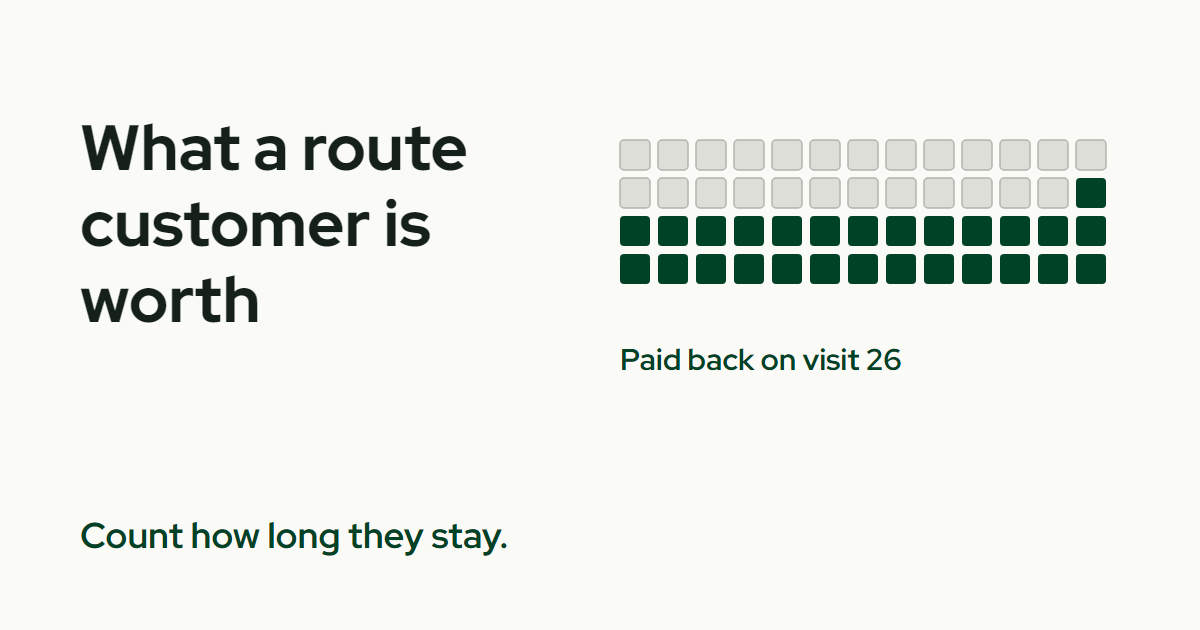
The payback lands on visit 26, about six months in. Everything before that is money you fronted.
What does a customer who leaves early cost me?
On a route, churn shows up as a stop that vanishes from the list. Each missing stop is a visit you no longer get paid for.
A customer who cancels after a month gave you four visits and $28 of the $180. That customer cost you $152. A customer who stays a year gave you 52 visits and $364.
Your billing record is the honest count. FetchPoop's public business listing says it bills monthly after the work is done, and that skips and snow days show up on the invoice. So the number that matters is visits billed, not visits on the calendar.
FetchPoop also says no contracts, which means a customer can leave any month. That makes the stay a number to measure.
Should I take a customer who adds a long haul?
Price the stop itself. Here are two weekly customers who both pay $12 a visit. The numbers are hypothetical.
| Customer | Cost per visit | Left per visit | Visits to pay back $180 |
|---|---|---|---|
| On a street you already visit | $5 | $7 | 26 |
| Across town | $8 | $4 | 45 |
The extra travel adds $3 a visit. Same price, same customer type, and the payback takes 45 visits instead of 26.
Neighbors of an existing stop fit the route, so channels that reach neighbors are worth pricing first. The guides on door hangers and Nextdoor start there.
How long do my customers stay?
I couldn't find a public figure for how long a route customer stays. Any number you read for it is a guess, so count your own.
- Pick every customer who started in one past month.
- Count how many still paid at 13 weeks, 26 weeks and 52 weeks.
- Repeat for a second starting month and compare.
Even 20 customers give you a first picture. Redo the count as the list grows.
How much can I spend to win a route customer?
More than a one-time job allows, and less than the full lifetime figure.
FetchPoop lists a one-time cleanup at a flat $50 for the first hour. Whatever you spent to find that customer has to come out of one $50 payment. A weekly customer pays again next week, which is why a route business can spend more to win one.
To set a limit, take the number of weeks most of your customers get past. Multiply it by what you keep per visit, then spend well under the result. In the example, 26 weeks at $7 is $182, so $180 leaves no room. A limit near $120 would.
If you reward referrals or reviews, count the reward as acquisition cost. The FTC says you can't condition an incentive on a review being positive.
What do I do next?
Pull your last 20 starts and count how many are still paying. Then read the short answer on CAC payback and what CAC means if the term is new.
A ProveWorth page lists your towns and your prices, so a neighbor can see what a visit costs before they call. You can get your free page or see how it works.
Sources

Founder, ProveWorth
Built ProveWorth - the trust layer for human communities. We surface real reviews from real members across hundreds of communities, so you can find the one that fits and join with confidence.
Frequently Asked Questions
What is customer lifetime value for a route business?
It is the money left after each visit, multiplied by the visits a customer stays for. The visits are the number to measure from your own customer list.
How long does a route customer usually stay?
I couldn't find a public figure, so use your own. Count how many customers who started in one month still pay after 13, 26 and 52 weeks.
What is one weekly customer worth over a year?
Multiply the money left per visit by 52, then cut it for skips and cancellations. In the worked example, $7 left per visit makes a full year $364.
Should I take a customer who adds a long haul?
Price the stop itself. Extra travel lowers what you keep per visit. In the hypothetical example, a $180 acquisition cost takes 45 visits to return instead of 26.
Do missed payments count?
Yes. Use the visits you billed and collected, not the visits on the calendar. A skipped visit or an unpaid invoice shortens the stay.
How much can I spend to win a route customer?
Less than you expect to keep over the weeks most customers stay, with room left for overhead. Do not spend the whole lifetime amount.
ProveWorth
Reviews on your own page
Your business gets a free page and your customers write what goes on it. We read each review, publish it, and email you so you can reply.
Get your free pageSee the websites we buildRelated Guides
Nextdoor for a local service business: the free page, the paid options and how to tell them apart
The Business Page is free. Paid promotion is separate, and Nextdoor prints no price for it. Here is how to set up the page and track each result.
What does a new customer cost your service business?
A worked table, the one-truck example, and the few numbers worth writing down each month.
Door hangers for a service business: what to write and where they go
A layout with one offer and one phone number, three copy examples, the mailbox rule and the nearby-job move.