Published Last updated
What a ProveWorth business page shows
Four live business pages read top to bottom, with what each section prints and what each label means.

Founder, ProveWorth

Key Takeaways
- 1Each page opens with the business's name, trade, towns and a Claimed or Unclaimed label.
- 2The ProveWorth check reads Trusted or New on ProveWorth, and the page lists the checks behind the label.
- 3The reviews section invites the first review, and each review that publishes appears there after ProveWorth has read it.
- 4Prices appear only where the business's own website published them, and the page says so.
- 5A Common questions block answers what customers ask, and every page ends with a line about getting a page for your own business.
A ProveWorth business page shows what the business offers, what ProveWorth checked about it, and the reviews customers write there. I read four live pages top to bottom: a pet waste company that has claimed its page, two that haven't, and a campground. Here is what each section prints.
What does the top of the page show?
The name, the trade, where the business works and a label saying Claimed or Unclaimed. Two buttons sit beside the name: Leave a review and Call.

Fetch N Clean Dog Waste Removal is the claimed page. It shows a Claimed label and its towns as pills under the name. Poopy Scoopers LLC adds a Since 2021 label. Seven Sisters Campground shows Campground and Homosassa, FL.
What do the About and Photos sections say?
About is a short description of the business and its plans. On Fetch N Clean, a small line above it reads Written by the owner. The other three carry no such line.
Under About sit links to the business's own website and, where it has them, Instagram, Nextdoor or Good Sam. A Photos section follows when the business has photos to show.
What is in the What customers say section?
Links to review pages outside ProveWorth, such as Google, Facebook, Nextdoor, Campspot and RV LIFE, plus a short written summary. On Fetch N Clean, the summary mentions yards that look clean after each visit and a text with a photo of the closed gate.
The section sits apart from ProveWorth reviews, and its text and links are separate from them. Yellowstone's version says the business doesn't have any reviews yet on ProveWorth or other sites that ProveWorth has found.
What does the ProveWorth check mean?
The What we checked section shows two tiles. The first is the ProveWorth check, which reads Trusted or New on ProveWorth, with a line under it. The second is ProveWorth reviews, which links down to the reviews section and invites the first review until one publishes.
Below the tiles, each page lists the checks it passed. Seven Sisters shows four. Its own website lists the same name, phone number and address. The Citrus County Chamber of Commerce lists the same phone number, and Discover Crystal River and Florida Rambler list the same address. The two pet waste pages that are New on ProveWorth show one: their website lists the same name, phone number and towns.
The trust page defines the labels. A page can read Trusted once at least two checks are done, and one must be the owner's claim, a government record or another public page. New on ProveWorth means the page was added in the last 90 days and isn't Trusted yet. The trust page also says a label doesn't judge the work itself, so you read the reviews for that.
Fetch N Clean's Trusted label carries a line reading Claimed by the owner. Seven Sisters' reads Listed by Citrus County Chamber of Commerce.
What does the reviews section show?
It shows the reviews customers write on ProveWorth, each one after ProveWorth has read it. Before the first one publishes, the section carries a Leave a review button and a line saying that writing the first review takes about two minutes.
A band lower on the page explains how reviews get checked. ProveWorth reads every review before it publishes, and reviewers who add proof, like a photo of the invoice or the work, get a Verified badge. The badge sits on that one review.
The trust page adds that Google reviews are never published on a ProveWorth page and never counted into a ProveWorth rating. The business's Google page stays one click away, through the See their other online reviews button.
What do the Services and Common questions sections list?
Services is a list of cards, a line or two each. The pet waste pages list their plans, such as weekly, twice-weekly and one-time cleanups, plus extras like waste haul-away. Seven Sisters lists RV sites by size, studio and one-bedroom cabins, kayak rentals and boat slips.
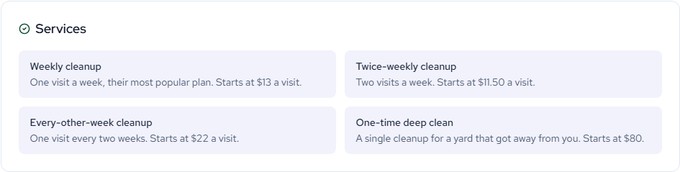
Poopy Scoopers and Yellowstone print prices, and both pages say the figures come from the business's own website. Fetch N Clean and Seven Sisters print none. For the numbers, see how much pet waste removal costs.
Common questions follows, answered in plain sentences. Yellowstone's questions cover cost, towns, snow, whether you need to be home, what happens to the waste, skipping a week, a very small yard and an unhappy customer. Seven Sisters answers kayak launches, rig size, hookups, pets, cabins, monthly stays and booking. On Fetch N Clean, the same block is titled Owner Q and A.
How does a page show where and when to reach the business?
A How to reach them panel lists a phone number, the website, an Open in Google Maps link and hours by day. The pet waste pages list the towns served, and a longer list folds into a Serving line that expands to show the rest. They also carry a coverage map and a line asking you to call to check your street.
Seven Sisters is a place, so it prints its street address instead, with a map and a Get directions link.
A Key facts table sums it up: trade, service area or location, services and a Listing line that reads either Claimed by the business or Not claimed yet. Poopy Scoopers adds In business since.
How are the four pages different?
| Page | Listing | ProveWorth check | Prices printed |
|---|---|---|---|
| Fetch N Clean Dog Waste Removal | Claimed | Trusted | None |
| Yellowstone Pooper Scoopers | Unclaimed | New on ProveWorth | Weekly and one-time rates |
| Poopy Scoopers LLC | Unclaimed | New on ProveWorth | Starting price for each plan |
| Seven Sisters Campground | Unclaimed | Trusted | None |
The same template holds all four. A pet waste company and a campground fill it with different facts and get the same sections in the same order.
How do I get a page like this?
Every page ends with a line that reads Get a page like this for your business. An unclaimed page also carries the claim banner at the top, and claiming it is free.
If you run a pet waste company, how to start a pooper scooper business shows what customers look for before they call. To see how the review side works, read how it works, or get your free ProveWorth page.
Sources

Founder, ProveWorth
Built ProveWorth - the trust layer for human communities. We surface real reviews from real members across hundreds of communities, so you can find the one that fits and join with confidence.
Frequently Asked Questions
What does Trusted mean on a ProveWorth page?
A page can read Trusted once at least two checks are done, and one must be the owner's claim, a government record or another public page. The label doesn't judge the work itself.
What does New on ProveWorth mean?
The page was added to ProveWorth in the last 90 days and isn't Trusted yet. It marks a page that is new to the directory.
What is the difference between Claimed and Unclaimed?
Claimed means the owner has taken over the page. An unclaimed page carries a banner inviting the owner to claim it for free.
Do these pages show Google reviews?
No. They link to the business's other review pages, but Google reviews are never published on a ProveWorth page or counted into a ProveWorth rating.
How do I get a page like this?
Join ProveWorth, or claim your page if it already exists. Every page ends with a line inviting you to get a page like it.
ProveWorth
Reviews on your own page
Your business gets a free page and your customers write what goes on it. We read each review, publish it, and email you so you can reply.
Get your free pageSee the websites we buildRelated Articles

How 16 local service businesses won customers
Sixteen public case studies, with who reported each result and what the number actually counted.

Partner offers and events for a pet waste removal business
A dog-care chain lists a 20% perk for a pet waste company, and another company promoted a free dog festival. Here is how to cost and count your own.

What automated review requests actually produced
Three NiceJob case studies report hundreds of new Google reviews. Here is what each one counted, and the one percentage that needed fixing.