
Published Last updated
How to start a pooper scooper business
What seven local price pages charge, and why a customer three streets from your last stop is worth more than one across town.

Founder, ProveWorth
Key Takeaways
- 1One vendor guide's startup lines add up to $1,050 to $2,800, including a year of insurance. Use it to bracket your budget until real quotes come in.
- 2Weekly one-dog service on seven published price pages runs about $10 to $20 a visit, or about $43 to $87 a month.
- 3Ask an agent about general liability first, then the pooper-scooper lines: animal liability, pet protection, vet reimbursement and lost-key liability.
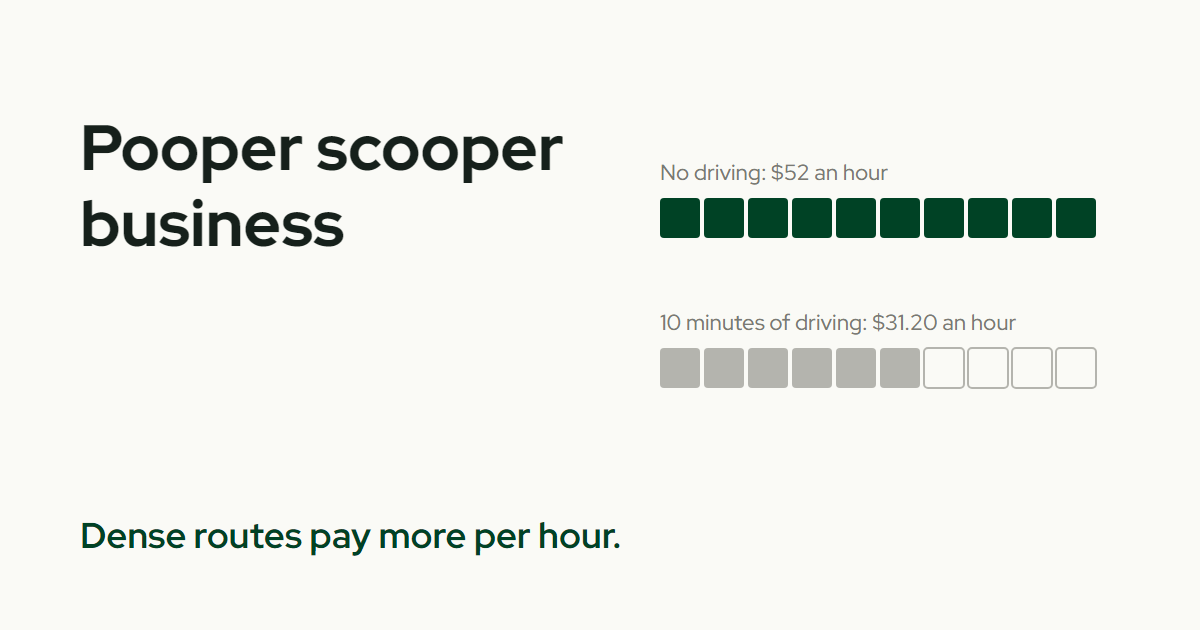
- 4In the worked example, 10 minutes of driving between stops cuts revenue per hour by 40% at the same price.
- 5License and permit rules vary by business activity, city, county and state, so check each one before your first customer.
Register the business, buy liability insurance, get a basic tool kit, then build a weekly route of customers who live close together. Single-dog weekly service on seven published price pages runs about $10 to $20 a visit. Check your city and state for license rules before your first customer.
The rest of this page is numbers. Every figure has a source named beside it, and the route arithmetic uses inputs I label as made up. A pooper scooper business is glamorous in exactly one way, which is the spreadsheet.
What does it cost to start a pooper scooper business?
It's a range, and the range depends on who published it. ZenBusiness, which sells business-formation services, lists these startup lines.
| Startup line | Range reported by ZenBusiness |
|---|---|
| Business registration and licensing | $100 to $500 |
| Commercial liability insurance | $400 to $800 a year |
| Sanitation tools and rakes | $100 to $250 |
| Trash bags and bins | $50 to $150 |
| Vehicle decals and uniforms | $200 to $600 |
| Initial local marketing | $200 to $500 |
| Route optimization software | $30 to $100 a month |
Add the first six lines and you get $1,050 to $2,800. That sum is mine. It includes a year of insurance and leaves out a vehicle and the software.
A Jobber author gives a lower number. Jobber sells scheduling software, and the author writes as a compensated brand ambassador. In that author's telling, about $1,000 gets you started, and gloves, a bucket, trash bags and a rake cost under $200.
Both figures are reported by a company with something to sell. Use them to bracket your own budget, and replace them with quotes as you collect them.
Do I need a license or a permit?
It depends on where you work. The SBA says license and permit requirements and fees vary with your business activities, location and government rules. Its page does not name pet waste removal.
So the method is the answer. Start at your Secretary of State site for state rules, then check your county and city sites. The SBA also notes that some licenses expire and suggests tracking renewal dates. Check your city and state before you take a first customer.
Do I need an EIN?
The IRS issues an EIN for free, and you can apply online. Its list of reasons to get one includes having employees. If you form an LLC or a corporation, register it with your state first.
Whether a one-person business with no employees needs one is a question for the IRS page or an accountant. A site that charges you for an EIN is selling you what the IRS gives away.
What insurance does a pooper scooper business need?
Insurers that write pooper-scooper policies treat general liability as the core. Pet Care Insurance's page lists the lines below, with its own limits where it prints them.
- General liability. The page lists $1,000,000 per incident and $2,000,000 per year.
- Animal liability. It lists $100,000 per incident and $200,000 per year.
- Animal bailee, which this insurer calls pet protection. It lists $2,500 per incident and $5,000 per year.
- Veterinarian expense reimbursement. The page says it pays you back for vet bills if a client's pet in your care needs emergency treatment.
- Lost-key liability. The page lists $2,000 and says it pays rekeying costs if you lose a client's keys.
- Commercial auto and workers compensation. Both are custom-quoted. The insurer says workers comp is required for businesses with employees in most states, so ask your state.
Insurance Canopy's page says a pooper-scooper policy starts at $194 a year. Read it as the floor of that insurer's range. TRUiC, which publishes educational pages on starting an LLC, puts general liability at about $300 to $700 a year for $1 million of coverage. ZenBusiness says $400 to $800.
Three sources, three ranges. Get your own quote, and ask the agent what each line pays for before you decide which to buy.
What should I charge?
Start by looking at what other businesses publish. The national brands I checked give quotes instead of prices, so this table uses seven local pages. The cost answer page names those brands and what each one says.
Each row is one business, in its own region, written at its own time. Don't average them into a market price.
| Price page | Weekly, 1 dog | Extra dog | Twice weekly, 1 dog | One-time or first cleanup |
|---|---|---|---|---|
| DoodyCalls Denver franchise page | $17.50 a visit | 2 dogs $20.00 | $13.25 a visit | None listed |
| DoodyCalls Jacksonville franchise page | $16 a visit | 2 dogs $19.50 | $14 a visit | A small surcharge, no figure |
| Independent with a three-town service area | $10 a visit | 2 dogs $11 | $8 a visit | $20 flat spring cleanup, $5 startup fee |
| Independent in Seaford, NY | $10 a week | $4 more per dog | Offered, no price | $2 a minute for the first cleaning |
| Independent in Wellton, AZ | $45 a month for 1 to 2 dogs | Not listed | Not listed | From $75 |
| Yellowstone Pooper Scoopers | $20 a week | $2.50 more per dog | Offered, no price | $100 an hour |
| Poopy Scoopers LLC | From $13 a visit | Depends on yard size and dog count | From $11.50 a visit | Deep clean from $80 |
Yellowstone and Poopy Scoopers both have ProveWorth pages, and both pages attribute the prices to the businesses' own websites. The Denver table is written for yards under half an acre.
Weekly one-dog service comes to about $10 to $20 a visit, or about $43 to $87 a month. That uses 52 visits a year spread over 12 months, which is 4.33 visits a month. The $45-a-month page works out to about $10.38 a weekly visit.
One pattern repeats. A second weekly visit costs less than the first. Take twice the twice-weekly price and subtract the weekly price, and the second visit adds $9 a week on the Denver page, $12 on Jacksonville, $6 on the three-town independent and $10 on Poopy Scoopers. That is my arithmetic on the rows. None of the pages states it as a policy.
One-time cleanups don't compare at all. They run from $75, from $80, $100 an hour, and $2 a minute (which is $120 an hour).
How many customers do I need, and why does the route matter more than the price?
A weekly customer at $13 a visit is $56.33 a month (13 x 52 / 12). Everything in this section is arithmetic on published prices, plus inputs I label as made up.
To reach $50,000 a year at $56.33 a month, you need 74 accounts (50,000 / 676). For $100,000, you need 148. That is revenue, before gas, insurance, disposal, taxes, vacations and cancellations.
Run the multiplication on any income range you read. Fifty accounts at $50 a month is $30,000 a year. A hundred accounts at $80 a month is $96,000.
Now the part that makes a route a route. Take a 15-minute yard, which is an example a route-software vendor gives, and a $13 visit. With no driving, you finish 4 yards an hour and earn $52 an hour.
| Drive time between stops | Yards per hour | Revenue per hour |
|---|---|---|
| 0 minutes | 4 | $52.00 |
| 10 minutes | 2.4 | $31.20 |
Same price, 40% less revenue per hour. The 15 minutes and the 10 minutes are illustrative inputs. The shape holds whatever inputs you use: a customer three streets from your last stop is worth more than the same customer across town.
One Jobber author says a technician can scoop an average of 125 homes a week. At $13 a visit that is $1,625 a week, or $84,500 a year, before the costs above. Read it as a ceiling from one person's practice, and build your own forecast from your own route.
Insurance is small against that revenue. A $194 policy is $16.17 a month, about 0.29 of a $56.33 customer. An $800 policy is $66.67 a month, about 1.2 customers.
Last, count what a new customer costs you. Say it costs $180 to win a customer who contributes $60 a month after delivery costs. Payback is three months, if the customer stays. Those inputs are hypothetical and they ignore churn, so read the customer acquisition cost guide and the route customer lifetime value guide before you trust a payback number.
Where does the waste go?
It goes in the customer's outdoor bin or in your truck, and both show up on real pages. Yellowstone Pooper Scoopers double-bags the waste and puts it in the customer's outdoor bin, or hauls it away for a small extra fee. Poopy Scoopers says it takes the waste with it on every visit. Fetch N Clean says the crew can haul it away so it doesn't sit in your trash can.
Hauling is where the permit question lives. Two vendor guides, from Routific and ZenBusiness, say some counties treat commercial pet waste as solid waste or ask for a hauler permit. Neither guide cites a statute. Call your county solid-waste office before you haul a single bag.
Is aPaws worth joining?
aPaws describes itself as a trade association of professional animal waste specialists. It says it holds members to a standard in the care and treatment of animals.
Its site has a Find a Pet Professional directory, a members area, a convention page and an International Pooper Scooper Week. It lists no dues and no eligibility terms, so ask it for both before you decide.
What will customers see when they look you up?
Three pet waste companies have ProveWorth pages you can read as examples. Fetch N Clean lists every plan it runs, plus waste haul-away, and says no plan needs a long-term contract. Yellowstone Pooper Scoopers prints its first-visit deep clean, how it handles snow and what happens to the waste. Poopy Scoopers prints a starting price for each plan.
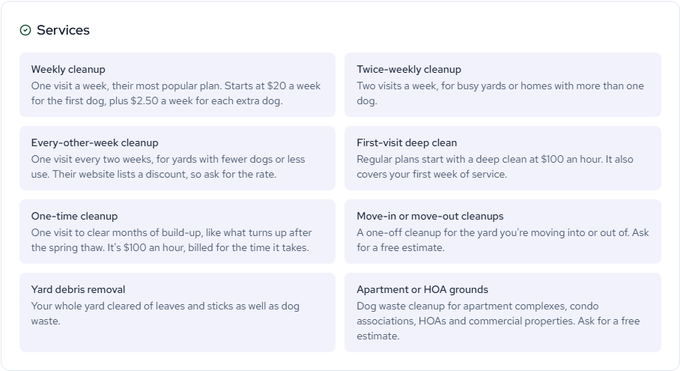
That is the bar. A customer who has to call to learn whether you haul the waste may just call someone else. What a ProveWorth business page shows walks through every section.
What do I do next?
Price your first route in a spreadsheet with the arithmetic above. Call your city and county, and ask an agent for quotes on the lines listed. Then look at partner offers and events and door hangers for ways to fill the route.
When customers start looking you up, get your free ProveWorth page or see how it works.
Sources
- SBA, apply for licenses and permits
- IRS, employer identification numbers
- aPaws, home page
- Pet Care Insurance, pooper scooper insurance
- Insurance Canopy, pooper scooper insurance
- TRUiC, business insurance for pet waste removal
- ZenBusiness, start a pet waste removal business
- Jobber, how to start a pooper scooper business
- Routific, how to start a pooper scooper business
- DoodyCalls Denver, pricing
- DoodyCalls Jacksonville, residential services
- Price page of an independent pet waste service, three-town service area
- Price page of an independent pet waste service, Seaford, New York
- Price page of an independent pet waste service, Wellton, Arizona
- ProveWorth page, Yellowstone Pooper Scoopers
- ProveWorth page, Poopy Scoopers LLC
- ProveWorth page, Fetch N Clean Dog Waste Removal

Founder, ProveWorth
Built ProveWorth - the trust layer for human communities. We surface real reviews from real members across hundreds of communities, so you can find the one that fits and join with confidence.
Frequently Asked Questions
Do I need a license to start a pooper scooper business?
It depends on where you work. The SBA says requirements and fees vary with your activities, location and government rules. Check your Secretary of State, county and city sites.
How much does it cost to start a pooper scooper business?
ZenBusiness lists startup lines that add up to $1,050 to $2,800, including a year of insurance. A Jobber author says about $1,000, with basic tools under $200.
How much should I charge for pet waste removal?
Seven published price pages list $10 to $20 a visit for weekly one-dog service. They come from different regions, so quote your own yard.
How many customers does a pooper scooper business need?
At $13 a visit, one weekly customer is about $56 a month. Seventy-four accounts reach $50,000 a year in revenue, before costs.
What insurance does a pooper scooper business need?
General liability is the core policy. Pooper-scooper policies add animal liability, pet protection, vet reimbursement and lost-key liability. Ask an agent which lines you need.
Is aPaws worth joining?
aPaws describes itself as a trade association of professional animal waste specialists. Its site lists no dues or eligibility terms, so ask it for both.
ProveWorth
Reviews on your own page
Your business gets a free page and your customers write what goes on it. We read each review, publish it, and email you so you can reply.
Get your free pageSee the websites we buildRelated Guides

How to track whether AI recommends your business
Ask three assistants the question your customer asks, once a month, and write down what they say. Tools come second.

Nextdoor for a local service business: the free page, the paid options and how to tell them apart
The Business Page is free. Paid promotion is separate, and Nextdoor prints no price for it. Here is how to set up the page and track each result.
Can you delete a Google review?
Who can delete one, what you can report instead, and the one shortcut that gets a business in trouble.